On an October morning, in a high-ceilinged court of the Royal Courts of Justice, a man in a full-bottomed wig and a black tricorne hat is handed a bundle of hazel twigs and a small hatchet, and handles them with the gravity of a surgeon. He is the King's Remembrancer, holder of the oldest judicial office in England, and he has come to collect the rent. The City of London tenders a blunt billhook, a keen-edged axe, six outsized horseshoes and precisely sixty-one nails — the annual due on two parcels of land whose exact whereabouts nobody has known for the better part of eight centuries. The billhook, as tradition insists, fails to bite; the axe swings clean through the wood. 'Good service,' murmurs the Remembrancer. The horseshoes are counted aloud, one by one. 'Good number.' And then everyone goes to luncheon.
Nowhere else on earth is a great financial capital governed, in part, by a pantomime of ironmongery. The Ceremony of Quit Rents is not staged for tourists — it is barely advertised, thinly attended, and performed with the straightest of faces. Which is precisely the point, and precisely where our inquiry begins. For before we can name London's most singular borough, we had first better decide what we are looking for.
There is a lazy assumption that eccentricity means fancy dress: purple hair, a monocle, a pet ferret on a lead. That is mere flamboyance, and flamboyance is often the least original thing a person can do. True oddity is a graver business.
It is sincerity carried past the point of embarrassment — the borough that does the strange thing not to be noticed, but because it has always done the strange thing and sees no earthly reason to stop. By that measure, half of London qualifies, and the other half is lying.
Any way you turn, you will see something someone may consider odd or unusual. But not the inhabitants of the borough itself. Greenwich, custodian of the Prime Meridian and the world's only Fan Museum, is odd in a nautical, well-mannered way — the eccentricity of a retired admiral. Brent conceals, behind a retail park, the marble immensity of the Neasden temple. Bromley shelters a lagoon of Victorian concrete dinosaurs, anatomically wrong and yet much loved for it. Richmond permits its deer to outrank its residents. All are peculiar; but none is peculiar enough to make the final five. Here, then, are the contenders on your ballot.
The five on the ballot
Camden wears its strangeness like a studded jacket, which is both its charm and its handicap. The borough took its name and its first bricks from Charles Pratt, first Earl Camden, who began carving streets out of open fields in 1791; the railway and the Regent's Canal did the rest, threading the place with sidings, wharves and a warren of subterranean vaults beneath the market that the Victorians dug for horses and pit ponies and that Londoners, with characteristic ghoulishness, insist on miscalling the Camden Catacombs. No corpses down there — only the old rope-haulage machinery that once dragged trains up the hill from Euston, and, on a good day, a film crew shooting a Bond picture.
Above ground, the roll-call runs from Walter Sickert, who painted the smoky glow of the old Bedford music hall and whose Camden Town nudes have kept amateur detectives busy for a century, to the Roundhouse — an 1847 engine shed that became a gin store and then, improbably, the temple where Pink Floyd, the Doors and Hendrix consecrated the counter-culture. Punk was assembled a few doors down; Britpop fought its skirmishes in the Good Mixer. Amy Winehouse now stands in bronze in the Stables, and the whole district still throngs, most weekends, with the wilfully odd. A mile or two north, Highgate 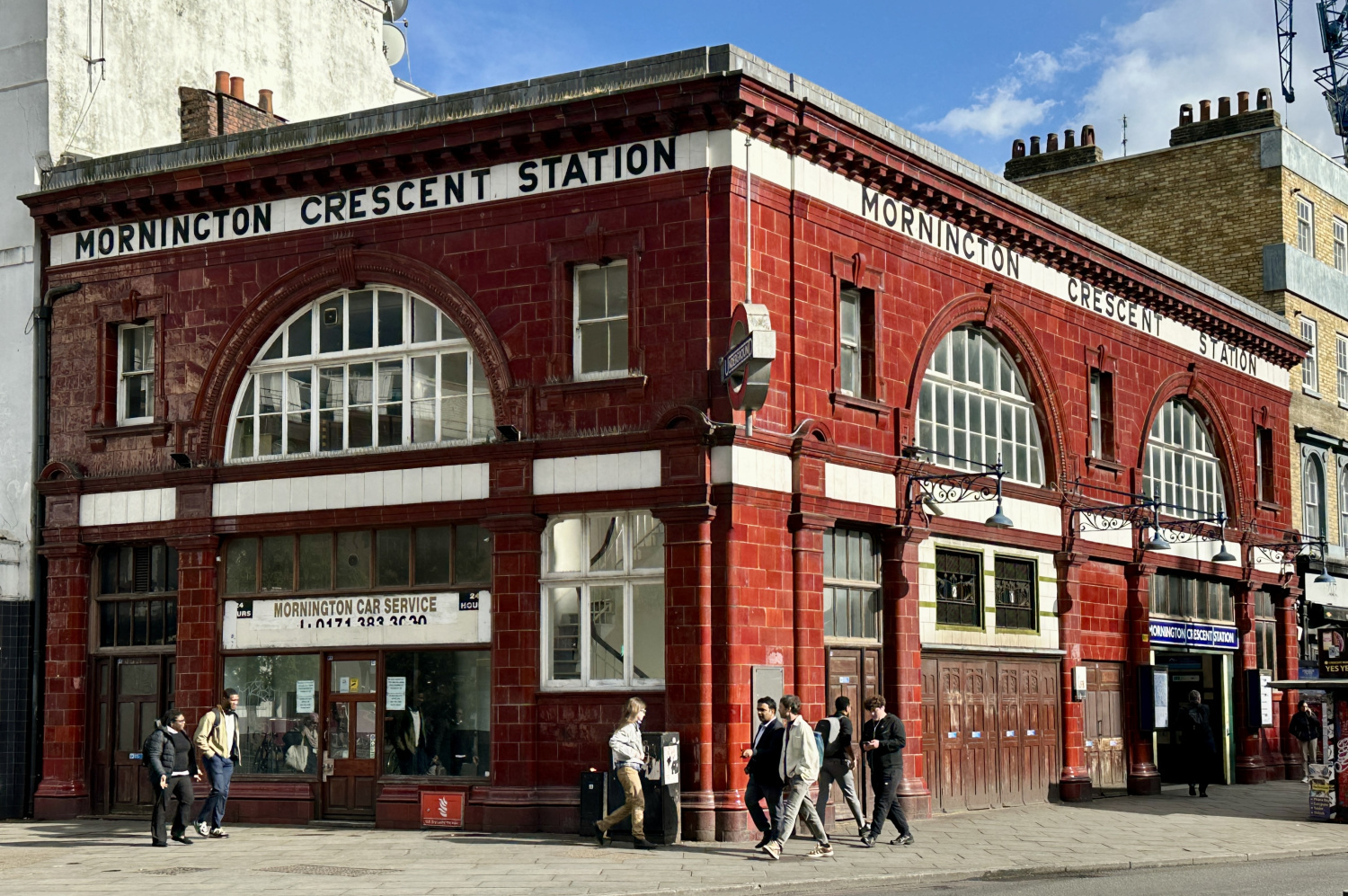 Cemetery lays on the borough's macabre streak in full: Karl Marx keeps eternal company there with a thicket of ivy and weeping angels and, in the early 1970s, with rival bands of self-appointed vampire hunters who mounted nocturnal stake-outs on Swains Lane after a newspaper scare had convinced half of north London that something undead walked abroad. The one custom the wider nation associates with the borough is the game of Mornington Crescent, that gloriously rule-free radio pastime named after its dowdiest Tube stop and devised as a joke about eccentricity itself. Which raises the question: is such knowingness a disqualification, or the very summit of the art?
Southwark was born disreputable and never quite recovered, which some will count the greater distinction. As the settlement at the wrong end of London Bridge — the defensive work of the men of Surrey, outside the City's writ — it spent centuries as the capital's licensed elsewhere, the place where you went to do the things you could not do at home. The Liberty of the Clink lay under the jurisdiction of the Bishop of Winchester, who taxed its brothels and licensed its prostitutes; the women were known, with grim local wit, as Winchester Geese, and to be 'bitten by a goose' was to catch something regrettable. Barred in death from consecrated ground, they were tipped into an unhallowed plot off Redcross Way.
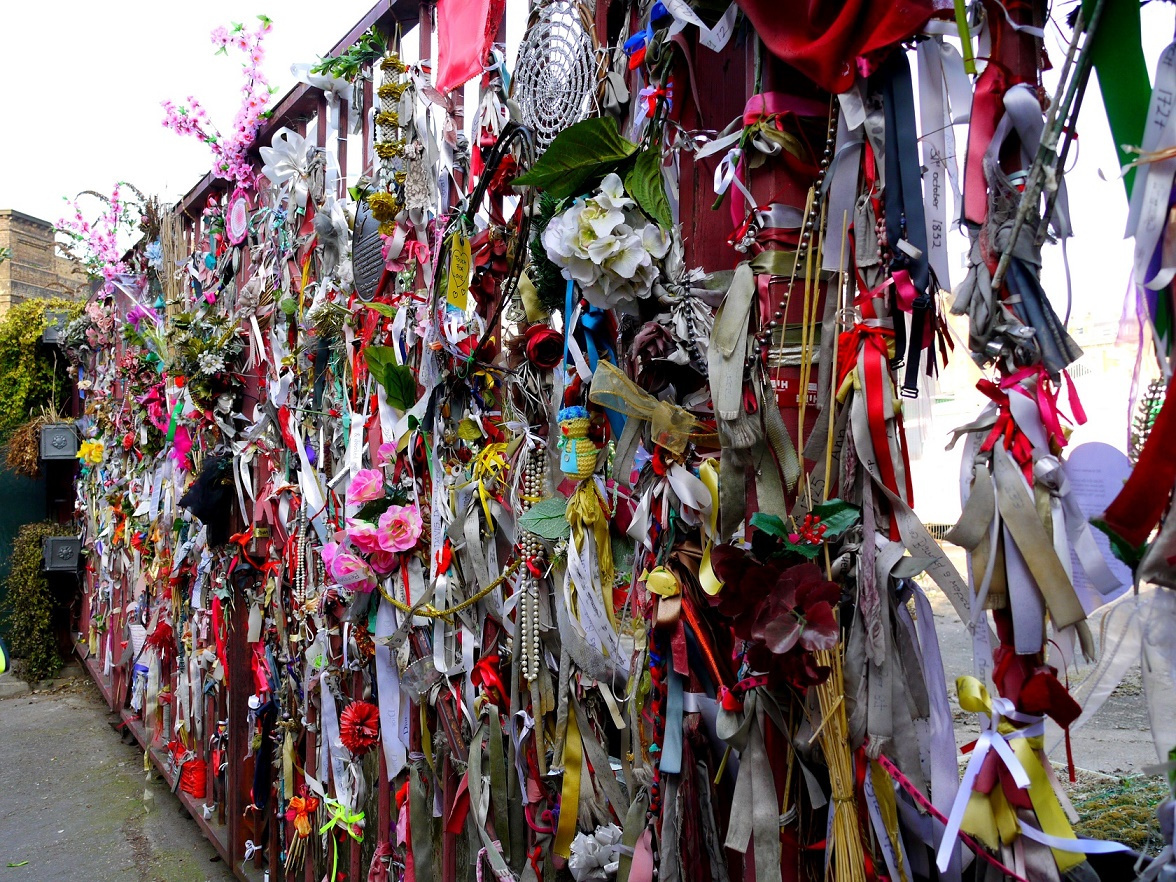 Today that plot, Cross Bones, is the most affecting shrine in London: a set of iron gates dressed in thousands of ribbons and feathers and paper messages to the outcast dead, tended by volunteers who hold a vigil on the twenty-third of every month. Nowhere states a borough's contrary soul more plainly — a garden of remembrance for the people the city preferred to forget. A few streets off, up a vertiginous spiral stair in the roof of a former church, survives the Old Operating Theatre — the oldest of its kind in Europe, mislaid for a century until its rediscovery in the 1950s — where surgeons once sawed above a tray of sawdust laid to catch the blood, watched by students packed into the rafters.
Southwark's statute book is a museum of the absurd. Elizabeth I, an enthusiast for the crueller pleasures, effectively forbade the Bankside playhouses from performing on Thursdays, lest they draw custom away from the bear-baiting.
And until 1994 the antiques dealers of Bermondsey traded under the medieval doctrine of marché ouvert, whereby goods bought there in the hours of darkness could not have their provenance questioned — a charter for the receiver of stolen property so brazen that the market kept its four o'clock opening chiefly so buyers could inspect the merchandise before the sun, and the law, came up. The loophole was shut only after paintings pilfered from Lincoln's Inn changed hands there for a hundred pounds apiece, and the aggrieved lawyers took their revenge in Parliament.
Westminster is really two boroughs pretending to be one: the marbled seat of church and state, and Soho, which is the seat of nothing whatsoever and proud of it. The name is said to preserve an old hunting cry, 'So-ho!', from the days when the ground was a royal chase; it became the foreigners' quarter, then the artists', then bohemia's world capital. Its temples are its drinking clubs. At the French House on Dean Street — where de Gaulle is supposed to have drafted his appeals, and Dylan Thomas mislaid the manuscript of Under Milk Wood — the house rule, honoured to this day, is that beer is served only in halves, save on the first of April.
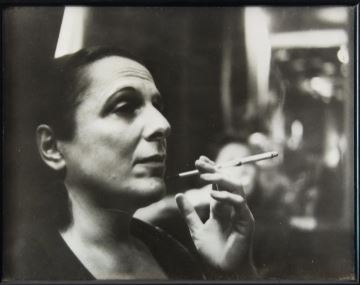 John DeakinMuriel BelcherAround the corner, up a foul-smelling staircase flanked by dustbins, Muriel Belcher ran the Colony Room, a tiny green box of a members' club where she greeted arrivals with an endearment far too famous yet still unprintable, kept Francis Bacon on a retainer to lure in wealthy patrons, and presided over the most gifted collection of drunks in the western hemisphere. From those same stools the columnist Jeffrey Bernard filed — or, more often, failed to file — his despatches, until the Spectator was reduced to printing the immortal apology, 'Jeffrey Bernard is unwell', a phrase that has since done duty at a thousand hungover breakfast tables. The green room is gone now, and the giants who drank there are ghosts; the halves are still poured. Soho hides odder things yet: somewhere on its walls survive the Seven Noses of Soho — plaster casts of a single human nose, stuck about the district in 1997 by the artist Rick Buckley in guerrilla protest at the spreading rash of CCTV, set quite literally under the cameras' noses. He kept his authorship secret for fourteen years, long enough for legend to supply the tale that whoever finds all seven will come into a fortune. Whether a borough may win on the strength of a glorious past is a matter, once more, for your conscience.
The City of London we have already met, wig and hatchet in hand. The Square Mile is not so much a borough as a survival — a self-governing enclave with its own Lord Mayor (emphatically not the Mayor of London), its own sheriffs, its own police force, and a body of ceremony so dense that a determined observer could spend a year doing nothing else. There is Swan Upping, when the Crown's Marker and the liverymen of the Vintners and Dyers row up the Thames each July to count the cygnets. There is Doggett's Coat and Badge, the oldest continuously contested race in the world, rowed since 1715 by watermen for a scarlet coat and a silver badge. There is the Knollys Rose, in which a single red bloom is carried on a cushion to the Lord Mayor to settle a fourteenth-century fine for an unlicensed footbridge — Sir Robert Knollys being abroad at the wars while his wife, Lady Constance, arranged the offending structure, of which readers may make what they will.
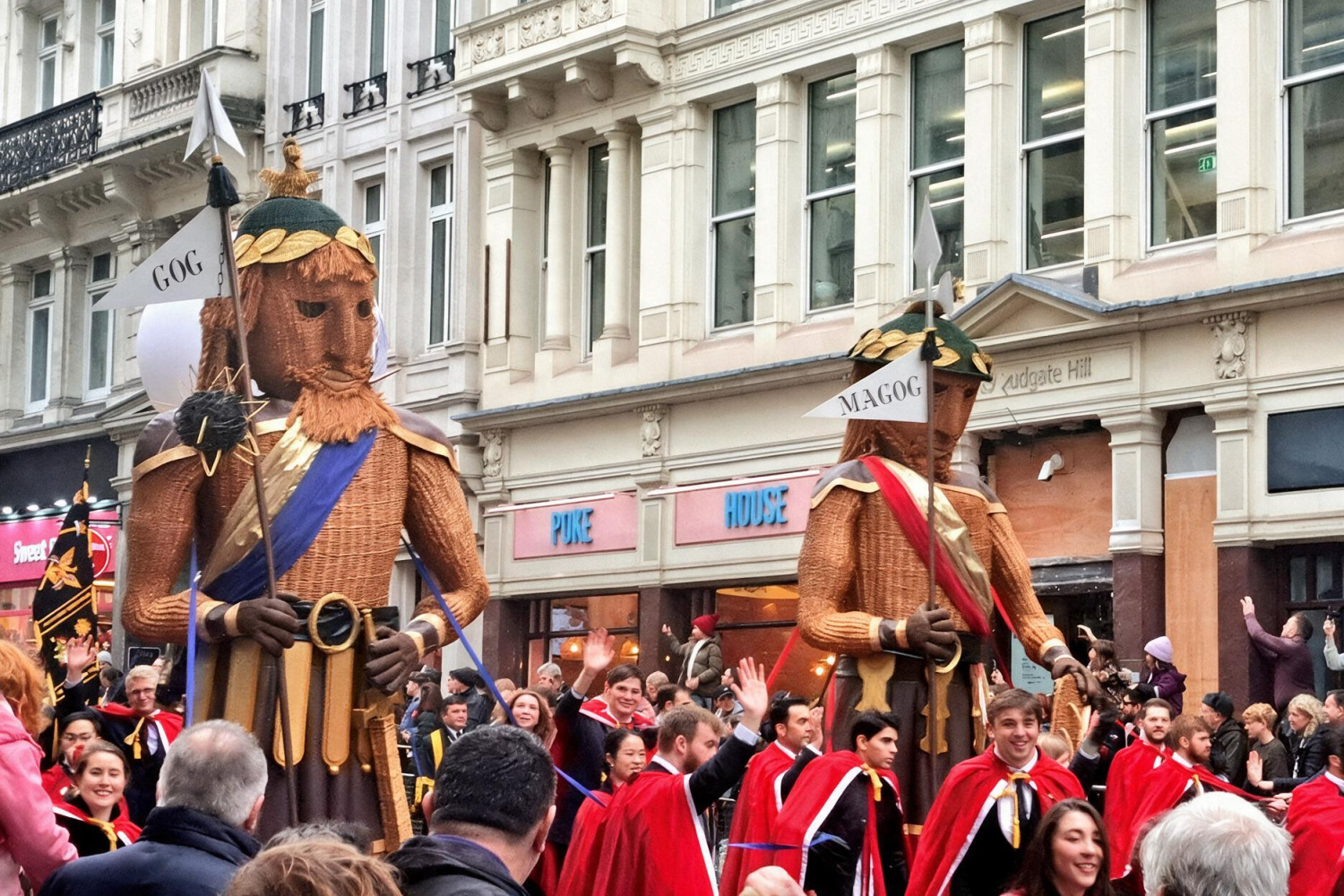 And at the head of the Lord Mayor's Show lurch Gog and Magog, two wicker giants nine feet tall, the mythical guardians of the City, chained (so the tale runs) to the gates of a palace on the site of the Guildhall, and paraded through the streets since the reign of Henry V. The City performs none of these rites for an audience. It performs them for itself, in deadly earnest, in the intervals of running one of the largest financial markets on the planet. It keeps humbler marvels besides: Postman's Park, whose wall of hand-painted tiles remembers ordinary people who died saving strangers; the Golden Boy of Pye Corner, a small gilt figure marking where the Great Fire of 1666 burned itself out and blaming the whole catastrophe, with breathtaking cheek, on the sin of gluttony; and, high on a wall in Philpot Lane, two carved mice squabbling over a crumb of cheese, the smallest public monument in London and the most touching. A purist may object that the City is not, strictly, a borough at all — a corporation older than Parliament has no business in a borough contest. We leave that objection on the table, for you to uphold or overrule.
Kensington and Chelsea has the deepest bench of characters. Chelsea began as a manor bought in 1712 by Sir Hans Sloane — physician, collector, and the man who, incidentally, popularised drinking chocolate and bequeathed the nation the founding hoard of the British Museum. The King's Road was, quite literally, the King's private road: until 1830 you could use it only if you carried a token stamped with the royal initials. From the middle of the nineteenth century the riverside filled with painters, and painters, as a class, are reliably strange.
Chief among them was Dante Gabriel Rossetti, who moved into Tudor House on Cheyne Walk and turned its garden into a private and calamitous zoo.
There were wombats, of which he was inordinately fond; there were owls, armadillos that burrowed under the neighbours' fences, kangaroos, a Brahmin bull that broke its tether and chased its owner round the lawn, and peacocks so piercing in their cries that Lord Cadogan is said to have written a ban on the birds into the estate's leases, where the clause reputedly lingers still.
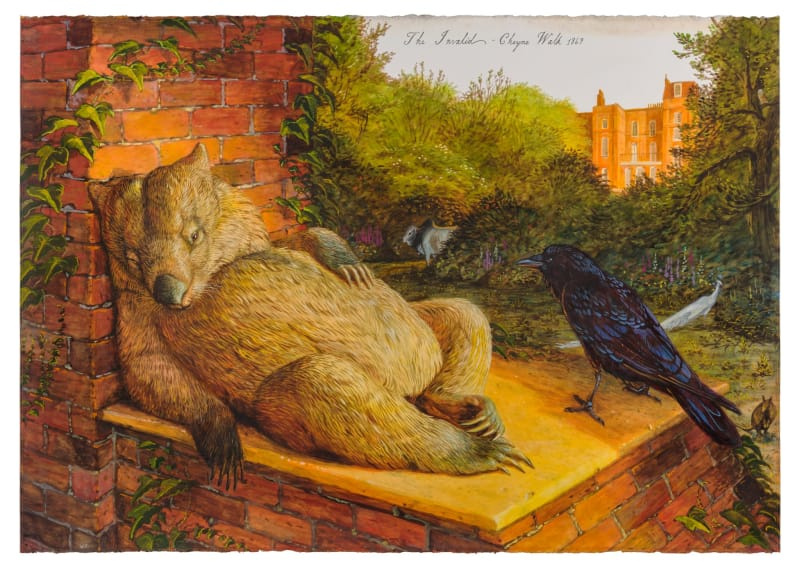 Walton FordThe Invalid – Cheyne Walk 1869A raccoon of criminal temperament ate several of Rossetti's manuscripts; one night the household woke to a fearful wailing that the poet took for the ghost of his dead wife, Lizzie Siddal, until his brother located the source — the raccoon, which Rossetti had absent-mindedly shut in a chest of drawers. Down the road lived Whistler, who sued Ruskin for calling one of his paintings a pot of paint flung in the public's face, won his case, and was awarded a farthing in damages — a sum so contemptuous it helped bankrupt him, and which he thereafter wore on his watch-chain. Later still came Quentin Crisp, self-styled stately homo of England, who, on principle, declined ever to clean his Chelsea room, having established that after the first four years the dust does not get any worse.
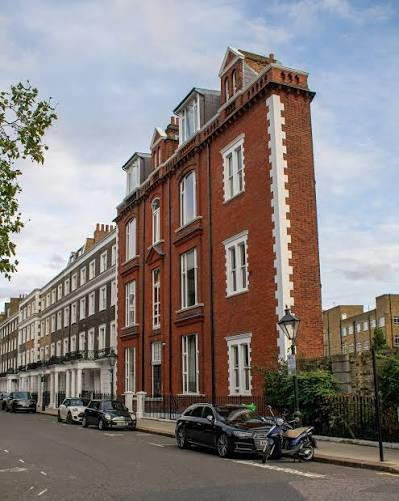 The borough's institutions match its residents. The Chelsea Physic Garden, walled since 1673, is the second-oldest botanic garden in the country and warms a corner of west London hot enough to ripen the largest outdoor fruiting olive in Britain. The Chelsea Arts Club still throws the bohemian party of the calendar; the Chelsea Flower Show turns horticulture into blood sport; and somewhere near Cheyne Walk stands a Victorian pillar box with two mouths instead of one, a small municipal absurdity that has outlived every attempt to explain it. Round the corner in South Kensington rises the Thin House at 5 Thurloe Square — a wedge of red brick a mere six feet across at its point, run up in the 1880s as artists' studios on a sliver of land the railway could not use, and narrow enough, from the right angle, to pass for a stage flat somebody forgot to strike. Today the district's reputation is for money rather than madness — which its champions will tell you is the cleverest disguise eccentricity ever wore.
So, the ballot is yours:
There, then, stand the five: Camden, worn and knowing; Southwark, magnificent and macabre; Soho, glorious and elegiac; the City, sublime and possibly ineligible; and Kensington and Chelsea, strange beneath its good tailoring.
How to vote. Cast your ballot in the poll below for the borough you judge the most eccentric of the five. One member, one vote; the returning officer's decisions are as arbitrary as the Quit Rents.
Or suggest your own. Should none of the five satisfy — nominate an alternative and make the case in a sentence or two. We can already hear the objections. Lambeth will be urged by those who recall that William Blake saw angels in a tree at Peckham and entertained the Almighty at Lambeth. Tower Hamlets will be pressed by the party of the ravens and the Ceremony of the Keys. Islington will be championed in the sardonic voice of Joe Orton...
Eccentricity, after all, is a thing best decided not by a single judge in a wig, but by a show of contrary hands.
Footnotes
Drawn from the literature of eccentric London — a shelf to which the diligent voter is warmly referred: Tom Quinn, London's Strangest Tales; David Long, Bizarre London; Benedict le Vay, Eccentric London; David Long, Bizarre London; J. Edward Hart, London: 101 Oddities (1994).
Which London Borough is most eccentric?
- Camden0%0 votes
- Southwark0%0 votes
- Westminster / Soho60%3 votes
- The City of London40%2 votes
- Kensington & Chelsea0%0 votes
5 votes in total · this poll is now closed
Comments (0)
No comments yet.
Commenting is for subscribers. Sign in or subscribe to join the conversation.