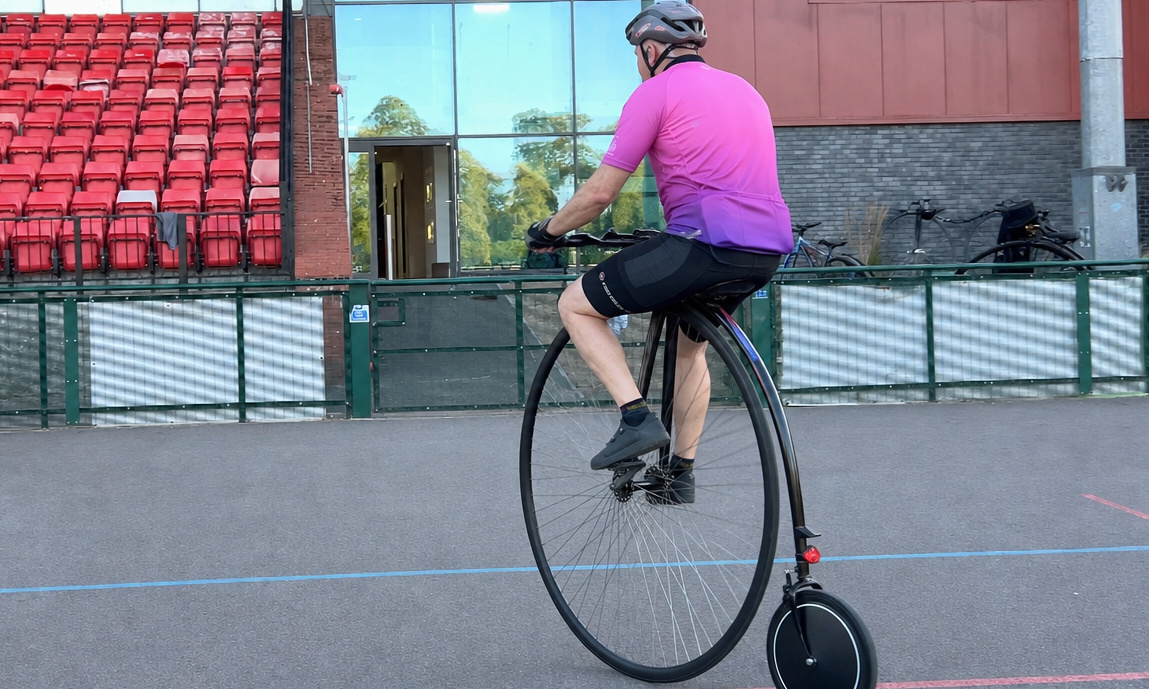
There is a particular sound a penny farthing makes at speed. Not the whir of a modern racing machine but something older and more precarious: the hum of a solid rubber tyre on a banked track, the creak of a leather saddle perched five feet in the air, and, beneath it all, the laboured breathing of a rider who knows that a moment's inattention will pitch him head-first over a wheel taller than he is. On the evening of Thursday 6th August, that sound filled Palmer Park Velodrome in Reading for five hours and twenty-three seconds without pause, as Rolf Woodward pedalled his way into the record books.
Woodward had set out to complete 100 kilometres — 62.1 miles — faster than anyone had ever managed on a high wheel. He succeeded, unofficially, in five hours and twenty-three seconds, and now waits for Guinness World Records to ratify what the assembled crowd had already witnessed. His verdict on the experience was characteristically unsentimental. "It was tough, it was painful, it was mental, but it's an achievement I've wanted to do for a while," he said afterwards, adding that his legs "felt like jelly" and that he would rather not repeat the exercise. Since he had set the mark for the first time, he noted drily, the record was now open to all comers — though he could not in good conscience recommend the attempt.
That gallows humour is, one suspects, a professional requirement among the small and singular fraternity who ride these machines competitively. And competitive is precisely the word. What might once have been dismissed as a heritage pursuit — the province of tweed-clad gentlemen wobbling gamely through village fêtes — has hardened, over the past decade, into a sport with a proper record ladder, international rivalries, and an appetite for punishment that would give a modern endurance athlete pause.
A family affair
The Reading endeavour was, appropriately, a dynastic one. Woodward belongs to what is fast becoming British cycling's most improbable ruling house: a family in which world records are passed around like heirloom silver. His wife, Julie, has held the mark for the fastest female kilometre; his young son and daughter, Finn and Flo, secured their own titles in June by riding the smallest rideable penny farthing ever built — a preposterous contraption whose front wheel measures barely eleven inches across. At Palmer Park, Julie stood trackside and applauded her husband through the small hours, a scene that captures something essential about this world. It is fierce, and it is also entirely a matter of kitchen-table enthusiasm.
The Reading gathering formed part of a two-day series of attempts staged by the Penny Farthing Club at the velodrome, running through Thursday and Friday. Founded in 2013, the Club has grown into the sport's organising spine, offering training courses, charity rides, track racing, Victorian-costume events and — a detail no satirist could improve upon — international penny-farthing polo. Its members already hold a formidable collection of Guinness titles, and the Reading programme was designed to add several more.
The supporting card read like a catalogue of inventive suffering. Richard Thoday — of whom more shortly — set out to ride continuously for a full twenty-four hours. Neil Laughton, the Club's founder, attempted the longest continuous ride with no hands, a discipline made cruel by the rule that forbids him from standing on the pedals to relieve his legs. There were attempts at the furthest distance without dismounting, the fastest 100 metres for both men and women, the furthest distance in an hour by a woman and by a tandem pairing, and Chloe Trigg's bid to reclaim the female kilometre record for Britain. The riders raised money throughout for Keep Me Breathing, a charity developing life-saving breathing technology for people with Congenital Central Hypoventilation Syndrome. Its chief executive, James Oakley — whose son Casper has the condition — praised the "skill, stamina and determination" on display as nothing short of extraordinary.
The men who ride into history
If the sport has a patron saint of masochism, it is Richard Thoday. A schoolteacher from Matlock in Derbyshire, Thoday spent the first week of his summer holiday in 2019 riding from Land's End to John o' Groats on a penny farthing, covering 874 miles in four days and eleven hours and fifty-two minutes. In doing so he demolished a record that had stood since 1886, when the celebrated Victorian cyclist George Pilkington Mills — then a teenager — completed the same journey in five days and one hour. Mills had pacers to draft behind and empty roads to enjoy; Thoday had traffic lights, tarmac and no one to shelter him from the wind. He rode roughly sixteen hours a day and finished with the flat observation that it had been the hardest thing he had ever done and that he would not be doing it again. At Reading, six years on, he was back in the saddle for a further twenty-four hours. Some men do not learn.
Thoday's ride belongs to a lineage of high-wheel heroics that reaches back to the machine's Victorian heyday and forward into a startlingly active present. The distance records still carry the names of nineteenth-century pioneers alongside their modern conquerors. The paced hour record, for instance, stood to the American William Rowe for well over a century — his 22.085 miles from Springfield, Massachusetts, dating to 1886 — until Chris Opie, aided by the round-the-world cyclist Mark Beaumont, edged past it in 2019 with 22.210 miles. Beaumont himself had earlier reclaimed the British hour mark from the Victorians, riding 21.92 miles at Herne Hill in 2018 to beat a figure that had gone unchallenged for 127 years, and pronouncing the machine "a tonne of fun" that "really, really hurts".
An arms race on solid rubber
What has changed, and changed swiftly, is the depth of the field. Guinness now tracks around thirty distinct penny farthing records, and the pace of their falling has accelerated to a degree that would astonish anyone who imagined the sport a dormant curiosity. The watershed was a single extraordinary weekend in October 2024, when the Penny Farthing Club staged a record "extravaganza" across Herne Hill Velodrome and the Lee Valley VeloPark. Thirteen records fell in three days. Opie clocked the fastest men's kilometre at one minute and 30.103 seconds. Guy Banham set the fastest men's flying speed at 41.56 kilometres per hour. Melissa Eisdell rode the furthest solo distance by a woman in an hour. And, in a feat of collective nerve that beggars belief, 140 riders — the broadcaster and amateur enthusiast Jeremy Vine among them — assembled themselves into the longest "stack" ever recorded, a self-supporting human-and-machine line held rigid for three minutes like a row of dominoes refusing to fall.
That the record for the fastest 100 metres while juggling now belongs to a Swede, or that the women's speed and kilometre marks were both claimed by a self-described Canadian "bike weirdo" at a Christmas carnival in Tasmania, tells you how genuinely international the competition has become. Riders travel from the United States, Sweden, Germany, Italy, France and Belgium for these gatherings. The results are contested to the hundredth of a second. This is not nostalgia; it is sport.
The championship crucible
For all Britain's recent industry, the sport's most prestigious annual prize is claimed at the other end of the world. The National Penny Farthing Championship at Evandale in Tasmania, instituted in 1983 and comprising fifteen separate events, remains the largest racing championship of its kind — the closest thing the high wheel possesses to a world series. It is there, on the same December carnival circuit, that some of the fastest marks on the ledger have been set, and it is against that Antipodean benchmark that British riders now measure their ambitions.
The effect is a virtuous circle familiar from any maturing sport. Better competition begets faster times; faster times draw better athletes; and the record ladder, once a sparse and dusty thing, grows more crowded with every velodrome meeting.
A discipline that spent most of the twentieth century as a footnote has, in the space of a few years, acquired the architecture of a real competitive endeavour — governing club, international calendar, ratified records, and a supporting cast of riders willing to sacrifice a great deal of comfort in pursuit of a certificate for the wall.
A word from the record-breaker
Rolf Woodward's Reading ride is the latest rung on that ladder, and by no means the last: the certificates accumulating on the family's walls suggest the Woodward dynasty has designs on a good many more.
The Eccentric has approached Rolf Woodward for a comment on his record and on the state of a sport that seems, improbably, to be entering a golden age. We hope to bring his reflections to our readers in the not-too-distant future.
For now, one is left with the image of that Thursday night at Palmer Park: a man five feet in the air, legs turning to jelly, wife applauding from the trackside, grinding out kilometre after kilometre on a machine his great-great-grandfather might have recognised.
The penny farthing was pronounced obsolete within a decade of its invention. More than a century and a half later, its wheel is turning faster than ever — and the people turning it have never been more determined to prove that the old high bicycle has a competitive life in it yet.
The riders' record attempts at Palmer Park were staged in aid of Keep Me Breathing (keepmebreathing.com).
Comments (0)
No comments yet.
Commenting is for subscribers. Sign in or subscribe to join the conversation.