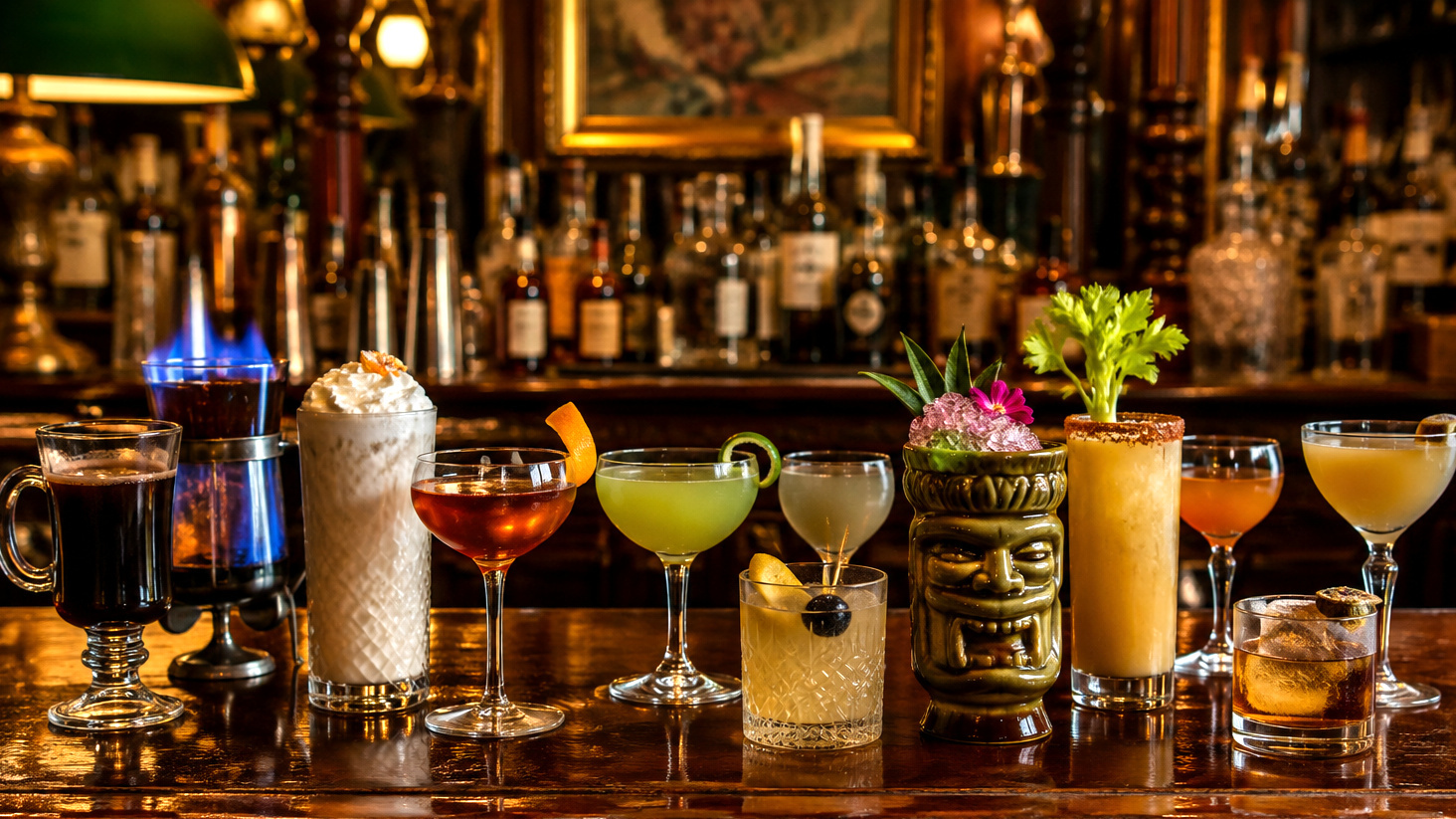
When someone orders a Ramos Gin Fizz at twenty past eleven on a Friday, he may expect a deservedly odd expression on a barman's face. It is not irritation, exactly. It is the expression of a man who has been asked to hand-copy a psalter while the room behind him fills up. He will glance at the queue, then at the clock, then at you, and in that glance is the whole history of the thing you have just requested: a drink invented in 1888 by a teetotaller with a perfectionist streak, which requires twelve minutes of continuous shaking and once obliged a New Orleans saloon to employ thirty-five boys to do nothing else.
He may make it anyway. Barmen are romantics, whatever they tell you.
The cocktail is one of the very few art forms in which eccentricity has proved a positive survival advantage. Sensible drinks vanish. Nobody now orders the sensible drinks of 1912. What endures is the drink that costs too much to make, or requires a naked flame, or carries a warning printed beside the recipe, or was named after a surgical procedure so disreputable that Britain outlawed it. Eccentricity is not a flaw in these formulas. It is the preservative.
What follows is a chronology of thirteen such drinks, running from a Victorian pot of porter warmed with a red-hot poker to a modern sour built on a base of bitters. All of them exist. All of them can be ordered somewhere on the surface of the earth tonight, though in one case you will need to reach Dawson City first, and a strong stomach will not go amiss.
I. The Dog's Nose (1836)
Warm porter, moist sugar, gin and grated nutmeg.
Dickens gave it to us in The Pickwick Papers, in a scene of pure comic malice. At a meeting of the Brick Lane Branch of the United Grand Junction Ebenezer Temperance Association, the secretary reads out the case of H. Walker, tailor, who confesses to having tasted dog's nose twice a week for twenty years. The committee, having made enquiries, helpfully supplies the recipe for the congregation's benefit: warm porter, moist sugar, gin and nutmeg. An elderly woman in the audience groans and confirms the formula from memory, which tells you rather more about the Brick Lane temperance movement than its secretary intended.
The eccentricity is in the method. Before the age of the gas ring, the porter was heated by plunging a loggerhead — an iron poker drawn red from the grate — directly into the tankard, which hisses, throws up a head of scorched malt and perfumes the whole snug. Cedric Dickens, the novelist's great-grandson, preserved the recipe in Drinking with Dickens in 1980. Attempted with a microwave, it is merely a warm beer with gin in it. Attempted with a poker, it is a small Victorian pantomime, but is rather good.
Recipe: 275ml (half a pint) porter; 25ml (1 fl oz) gin; 1 teaspoon moist brown sugar; grated nutmeg. Warm the porter to just below a simmer, stir in the sugar, add the gin off the heat, grate nutmeg over. The poker method, for those with a working grate: heat the iron until dull red, plunge it into the tankard of porter, and stand back. Nutmeg last, always, or you lose the aroma to the steam.
II. The Blue Blazer (c. 1850s)
Scotch whisky, boiling water, sugar, lemon peel. Set alight.
Jerry Thomas, the first celebrity barman and the author of the first American drinks manual, is supposed to have improvised this at the El Dorado gambling saloon in San Francisco for a customer who wanted something that would shake him down to his gizzard. Thomas obliged by igniting cask-strength whisky and pouring it, blazing, between two silver-plated mugs held some distance apart, so that the room saw an unbroken arc of fire. His own book, How to Mix Drinks (1862), describes the effect as a continuous stream of liquid fire, and then, with admirable practicality, advises the novice to rehearse for some considerable time using cold water.
The flame is not merely decorative: it lifts the whisky's aromatics and takes the harsh edge off the spirit. Thomas is said to have restricted the drink to genuinely cold nights or genuine invalids, which is the sort of rule a showman invents in order to be seen breaking it. Legend adds that Ulysses S. Grant, having watched one made, presented Thomas with a cigar from his own breast pocket. Any barman who offers you a Blue Blazer today is either very good or about to become very sorry.
Recipe: 60ml (2 fl oz) Scotch whisky, cask strength for preference; 60ml boiling water; 1 teaspoon caster sugar; a twist of lemon. Two metal mugs with handles. Warm the whisky, ignite it, and pour the burning liquid from one mug to the other in a long stream, four or five times, before adding the sugar and lemon. Rehearse with cold water until the arc is reliable. Do it away from soft furnishings, and do not attempt it having already drunk one.
III. The Ramos Gin Fizz (1888)
Gin, lemon, lime, sugar, cream, egg white, orange flower water, soda.
Henry Charles Ramos — Carl, to those who knew him — bought the Imperial Cabinet Saloon in New Orleans and there assembled the most laborious drink in the canon. Gin, two citrus juices, sugar, cream, egg white and a whisper of orange flower water, shaken until the mixture reaches a state closer to meringue than to liquid. The original stipulation was twelve minutes. Twelve. The shaker frosts so hard it has to be wrapped in a cloth before a human hand can hold it.
Demand made this untenable, so Ramos hired relays of shaker boys who passed the tin down the line, each taking a turn before his arm gave out. Stanley Clisby Arthur, chronicler of the city's drinks, recorded that thirty-five of them nearly shook their arms off during the Mardi Gras of 1915 and still could not keep pace. The delicious absurdity is that Ramos himself disliked drunkenness, ran a strict house and shut at eight sharp. On the eve of Prohibition he published the recipe in a New Orleans paper, apparently convinced that nobody would ever have cause to make it again. Senator Huey Long later thought it important enough to fly New Orleans barmen to Manhattan so that the New Yorker Hotel could learn the trick.
Recipe: 60ml (2 fl oz) gin; 15ml (½ fl oz) lemon juice; 15ml lime juice; 15ml sugar syrup; 30ml (1 fl oz) double cream; 1 egg white; three drops orange flower water; soda to finish. Shake everything but the soda without ice for a minute, then with ice for as long as your arm holds out — twelve minutes if you are honest, two if you are not. Strain into a chilled glass, rest for a moment, then pour soda down the inside of the shaker and into the centre, so the foam rises above the rim. Three drops of orange flower water, not four; it is the one ingredient that can ruin the drink single-handed.
IV. The Hanky Panky (c. 1903–1921)
Gin, sweet vermouth, two dashes of Fernet-Branca.
Ada Coleman — Coley — ran the American Bar at the Savoy and was, for a period, the most celebrated barmaid in England, mixing for Mark Twain, for the Prince of Wales, and for the Edwardian actor Sir Charles Hawtrey (the mentor of Noël Coward, and no relation to the later gentleman of the Carry On films). Hawtrey, tired after a run of overwork, asked her repeatedly for something with a bit of punch in it. Coleman spent hours experimenting and produced a sweet martini stiffened with two dashes of Fernet-Branca — at the time a bottle regarded as belonging in the medicine chest rather than the back bar.
She told the story to The People in 1925. Hawtrey drained the glass and pronounced it the real hanky-panky, a phrase which then meant conjuring or sleight of hand rather than anything requiring a chaperone. The drink is her monument, printed in Harry Craddock's Savoy Cocktail Book in 1930 and served at the same bar to this day. Two dashes of Fernet is a homeopathic quantity of a very loud liqueur, and the fact that it works at all is the trick to which the name refers.
Recipe: 45ml (1½ fl oz) gin; 45ml sweet vermouth; 2 dashes Fernet-Branca; orange twist. Stir with ice, strain, squeeze the twist over the surface and drop it in. Resist the temptation to increase the Fernet. The whole point is that it should be detectable and not identifiable.
V. The Last Word (1916)
Equal parts gin, green Chartreuse, maraschino, lime.
Four ingredients in identical measures, one of them a liqueur made by Carthusian monks to a formula known to a handful of them at a time: the Last Word ought by rights to be undrinkable and is instead one of the great balancing acts. Clubland archives show it on the menu at the Detroit Athletic Club by 1916, at thirty-five cents, the most expensive thing on the list.
Its survival is a chain of improbable accidents. Frank Fogarty, a vaudeville monologist billed as the Dublin Minstrel, appears to have encountered it on a visit to the club and carried it back to New York. Michigan went dry in 1918, the DAC obeyed the law where grander institutions did not, the barmen dispersed and the recipe went with them. It surfaced once, in Ted Saucier's Bottoms Up! of 1951, credited to the club and to Fogarty's evangelism, and then sank again for half a century. In 2003 Murray Stenson, working at the Zig Zag Café in Seattle, was reading old bar manuals for something nobody else was pouring. He found it, put it on the list, and within a decade it was being drunk in every city with pretensions. A drink resurrected by a barman with a library card.
Recipe: 22.5ml (¾ fl oz) each of gin, green Chartreuse, maraschino and fresh lime juice. Shake hard with ice, strain into a coupe, no garnish. The equal-parts formula is exact and does not survive improvisation; maraschino in particular will take over the drink if given a millilitre of encouragement.
VI. The Monkey Gland (c. 1919–1923)
Gin, orange juice, grenadine, a dash of absinthe.
No cocktail has a more disgraceful namesake. Serge Voronoff, a Russian-born surgeon in Paris, had concluded from observing eunuchs that glandular decline caused ageing, and proposed a remedy: grafting thin slices of chimpanzee testicle into the scrota of ageing men. His first such operation on a human took place on 12 June 1920. Voronoff promised rejuvenation, restored vigour and, in his more expansive moments, a human lifespan of 140 years. Millionaires, aristocrats and at least one head of state submitted. Some forty-five surgeons trained with him. Britain, to its credit, banned the practice.
However, the drink is a rather good one — gin sharpened with orange, sweetened with grenadine and given a green shadow of absinthe — and its paternity is contested. Harry MacElhone of Harry's New York Bar in Paris claimed it in Barflies and Cocktails (1927); Frank Meier of the Ritz also put in a bid. The drinks historian Wayne Curtis points out that the chronology defeats both, since the Monkey Gland was already a sensation in London by 1919 and was still being touted as a speciality of Romano's in the Strand in 1923. What is certain is that a fashionable quackery gave a fashionable drink its name, and only one of the two survived.
Recipe: 60ml (2 fl oz) gin; 30ml (1 fl oz) orange juice; 2 teaspoons grenadine; a dash of absinthe. Shake with ice and strain. Real grenadine, made from pomegranate, or the drink turns to boiled sweets. Some hands substitute Bénédictine for the absinthe, on the authority of a competing early recipe; both versions have a claim, and neither involves a chimpanzee.
VII. The Corpse Reviver No. 2 (1930)
Equal parts gin, Cointreau, Kina Lillet, lemon. One dash of absinthe.
The Corpse Revivers were a Victorian family of morning drinks, most of them mercifully lost. Harry Craddock preserved two in The Savoy Cocktail Book. The first he prescribed for before eleven in the morning, or whenever steam and energy are required. Beneath the second he set down the most quoted line in cocktail literature: four of these taken in swift succession will unrevive the corpse again.
It is the perfect house style — the recipe as gentleman's warning, the joke delivered flat. The drink itself is a sour of exemplary construction, all citrus and quinine and a phantom of anise, and it goes down with such ease that Craddock's arithmetic begins to look conservative. There is a further eccentricity: it can no longer be made as written. Kina Lillet, the quinine-laced aperitif Craddock specified, was reformulated out of existence, and the modern devout reach for Cocchi Americano instead. Every Corpse Reviver No. 2 poured today is, strictly speaking, a reconstruction.
Recipe: 22.5ml (¾ fl oz) each of gin, Cointreau, Cocchi Americano and fresh lemon juice, with the glass rinsed in absinthe and the excess discarded. Shake, strain into the rinsed coupe. Craddock wrote Kina Lillet, which no longer exists in the form he knew; Cocchi Americano is the accepted stand-in, and modern Lillet Blanc is not, having lost most of its quinine. His arithmetic on the fourth glass should be treated as a measurement rather than a joke.
VIII. The Zombie (1934)
Three rums, lime, falernum, grenadine, absinthe, cinnamon, grapefruit, bitters.
Ernest Raymond Beaumont Gantt reinvented himself as Donn Beach, opened Don the Beachcomber in Hollywood the year after Repeal, and invented an entire aesthetic. He also invented a security system. Fearing rivals who poached his barmen, Beach numbered the bottles behind his bar and wrote his recipes in code, so that the men mixing the drinks had no idea what was in them. Don's Mix, Spices #4: the staff pulled from unlabelled bottles and shrugged.
The Zombie was the flagship, and Beach imposed a limit of two per guest — part prudence, part marketing genius, since nothing sells a drink like being rationed. He called it a mender of broken dreams. The code held for seventy years. Jeff Berry, the tiki historian better known as Beachbum, began work on the puzzle in 1994; a breakthrough came in 2005 when a former Beachcomber barman's daughter produced the notebook her father had carried in his shirt pocket, and the last cipher was cracked with the help of another veteran who remembered what Spices #4 actually was. Cinnamon syrup. Seven decades of secrecy, protecting cinnamon.
Recipe (Jeff Berry's reconstruction): 45ml (1½ fl oz) gold Puerto Rican rum; 45ml dark Jamaican rum; 30ml (1 fl oz) 151-proof Demerara rum; 22ml (¾ fl oz) fresh lime juice; 15ml (½ fl oz) falernum; 15ml Don's Mix; 1 teaspoon grenadine; 6 drops Pernod or absinthe; a dash of Angostura. Blend with 170g crushed ice for no more than five seconds, pour into a tall glass, top with ice, garnish with mint. Don's Mix is two parts fresh grapefruit juice to one part cinnamon syrup.
IX. Death in the Afternoon (1935)
A jigger of absinthe. Iced champagne to the top.
In 1935 Farrar & Rinehart had the inspired idea of asking thirty authors each to invent a cocktail and name it after one of their own books. The resulting volume, So Red the Nose, or Breath in the Afternoon, opens with Hemingway, because of course it does. His contribution borrows the title of his 1932 bullfighting book and consists of a jigger — an ounce and a half — of absinthe in a champagne glass, topped with iced champagne until it reaches, in his phrase, the proper opalescent milkiness. His instruction on consumption: drink three to five of these slowly.
He supplied a provenance too, claiming the formula was arrived at with three officers of HMS Danae after seven hours in the water trying to free a fishing boat from a sandbank in a north-westerly gale. The compilers added an admiring paragraph on his capacity. Modern practice reduces the absinthe by half or more, and modern practice is correct, but there is something splendid about a recipe whose most contentious element is not an ingredient but a dosage instruction.
Recipe: 45ml (1½ fl oz, a jigger) absinthe in a champagne glass, topped with iced champagne to what he called the proper opalescent milkiness. His instruction was to drink three to five slowly. In practice, 15 to 20ml of absinthe produces a drink that can be finished and remembered.
X. The Suffering Bastard (1942)
Gin, brandy, lime, bitters, ginger beer.
Joe Scialom, an Egyptian Jew of Italian descent, trained as a chemist, decided he preferred mixing drinks to mixing reagents, and installed himself behind the Long Bar at Shepheard's Hotel in Cairo — so called not for its dimensions but for the wait. He spoke eight languages. He served so many heads of state that the Egyptian government eventually imprisoned and expelled him for espionage, an experience which produced his motto: mix well, but shake politics.
In 1942, with decent spirits scarce and British officers suffering accordingly for the rough stuff they were drinking, Scialom improvised a restorative from gin, brandy, lime, bitters and ginger beer. Rommel was said to have promised himself champagne at Shepheard's before the year was out — a remark repeated everywhere but traceable nowhere, which is the usual condition of remarks that become legends. He did not get the chance. The story attached to the drink, repeated widely yet nowhere documented, is that a telegram arrived from the front at El Alamein requesting eight gallons of the stuff, and that Scialom filled every container he could lay hands on and sent it. Which spirits went into it is still disputed. Scialom told Robert Ruark of Collier's in 1953 that he had reached for gin and bourbon, two things he happened to have, and remarked that he had never thought they married; his daughter's account gives brandy. The world settled on brandy, which may mean the world corrected him, or may mean the world has spent eighty years overruling the inventor without troubling to say so.
Recipe: 30ml (1 fl oz) gin; 30ml brandy, or bourbon if you side with Scialom's own account; 15ml (½ fl oz) fresh lime juice; 2 dashes Angostura; 120ml (4 fl oz) ginger beer. Shake all but the ginger beer, strain over ice into a tall glass or mug, top up, garnish with mint and a slice of orange. Ginger beer rather than ginger ale gives the better drink, though the 1953 account specifies ale.
XI. The Bloody Caesar (1969)
Vodka, clam-infused tomato juice, Worcestershire, celery salt rim.
Walter Chell, running the bar at the Calgary Inn, was asked to devise a signature drink for the hotel's new Italian restaurant. He took three months over it. His inspiration was spaghetti alle vongole, and he pursued the idea with a literalism that beggars belief: he mashed clams by hand to produce a nectar, blended it with tomato juice and spices, added vodka and a dash of Worcestershire, rimmed the glass with celery salt and — he insisted to a reporter shortly before his death — a little oregano, and no Tabasco at all.
He called it a Caesar. An English guest at the bar, having tasted it, is supposed to have declared it a bloody good Caesar, and the adjective stuck. Mott's launched Clamato the same year, which is either a remarkable coincidence or a hint that the story is tidier than the history; an American drink called the Clamdigger, vodka with Clamato, was already being advertised in Texas in 1968. Canadians now get through something in the region of four hundred million Caesars a year, and it is everywhere described as their national cocktail, allegedly recognised as such by their parliament in 2009 or 2010. Historical records show a Mott's marketing campaign for the drink's fortieth anniversary, an online petition, and a company vice-president telling the CBC they hoped to take the thing to Parliament Hill and see whether it might be acknowledged. Though the Canadian Encyclopedia, describing the campaign in full, does not mention any parliamentary declaration at all. Order one south of the border or in London, and you will be stared at.
Recipe: 45ml (1½ fl oz) vodka; 120ml (4 fl oz) Clamato or clam-and-tomato juice; 4 dashes Worcestershire; 2 dashes hot sauce; salt and pepper; celery salt rim; celery stick. Rim the glass with a lime wedge and celery salt, build over ice, and mix by rolling the drink between two glasses rather than shaking. Chell insisted on a little oregano and no Tabasco at all, which almost nobody now observes, including Canada.
XII. The Sourtoe Cocktail (1973)
Any strong spirit. One mummified human toe.
We arrive at the reason the word eccentric requires a wide definition. During Prohibition a Yukon rum-runner named Louie Linken is said to have frozen his big toe solid while mushing through a blizzard; his brother Otto amputated it with a woodcutting axe, using overproof rum as anaesthetic, and they pickled the trophy in a jar as a memento. Half a century later a riverboat captain named Dick Stevenson found the jar while clearing out a cabin he had bought in Dawson City, and arrived at the conclusion that would define his life: that it would make a fine garnish.
He carried it to the Sourdough Saloon at the Downtown Hotel in 1973 and began dropping it into the glasses of the brave. The Sourtoe Cocktail Club has one rule, delivered in verse: you can drink it fast, you can drink it slow, but your lips must touch the toe. Stevenson thought perhaps a dozen people might ever do it. The membership has since passed ninety thousand. Toes wear out, and are replaced by donation — one arrived with a note advising against open-toed sandals while mowing the lawn. Swallowing one incurs a fine and, in the notorious 2013 case, expulsion from the town. Stevenson, who died in 2019, willed his own toes to the bar and instructed his daughter in their preparation, which she has described as the strangest errand ever laid on a daughter by a father's will. She is most certainly right.
Recipe: We ought to skip this one. Go to Dawson City, ask there.
XIII. The Trinidad Sour (2009)
Angostura bitters, orgeat, lemon, rye whiskey.
Every bar on earth has a bottle of Angostura, dispensed in dashes, treated as seasoning. Nobody had thought to treat it as a spirit, which — at 44.7 per cent, tasting powerfully of clove and cinnamon and gentian — it demonstrably is. The Italian barman Valentino Bolognese pointed the way in 2008 with the Trinidad Especial, which won an Angostura competition. The following year Giuseppe González, working at the Clover Club in Brooklyn, swapped pisco for rye and lime for lemon and built his version around a full ounce and a half of the stuff.
Entered in competition, it was a total failure, missing the top ten. A four-ounce bottle makes two drinks, which does nothing for the margins. González simply put it into the hands of other barmen and let it travel by word of mouth, and it went round the world by the slow route, arriving eventually on the International Bartenders Association's list of modern classics. The oiliness of the bitters gives it a texture most sours need an egg white to achieve. It is deep mahogany, faintly medicinal, and by a considerable margin the strangest genuinely delicious thing you can be handed in a glass.
Recipe: 45ml (1½ fl oz) Angostura bitters; 30ml (1 fl oz) orgeat; 22ml (¾ fl oz) fresh lemon juice; 15ml (½ fl oz) rye whiskey. Shake hard with ice and strain into a coupe. Yes, the bitters are the base and the whiskey is the modifier; yes, that is most of a small bottle for one drink. The oils in the Angostura give the texture, so orgeat of decent quality matters more here than in anything else on this list.
A note on the survivors
Thirteen drinks, and not a sensible one among them. What they share is not potency, or obscurity, or even novelty. It is that each was made by somebody who declined to do the obvious thing at the moment the obvious thing was available — Ramos declining to shake for two minutes, Beach declining to label his bottles, Coleman declining to leave the Fernet where the chemists had put it, González declining to treat bitters as a condiment.
That is the whole eccentric principle, distilled to four ounces and served up. The world is full of perfectly adequate drinks, mixed rapidly by capable people, and they will all be forgotten. What survives is the folly that somebody committed to entirely.
Members are reminded that the Club cannot provide the above until it finds a permanent clubhouse once again. So, dig deep and donate generously!

Comments (0)
No comments yet.
Commenting is for subscribers. Sign in or subscribe to join the conversation.