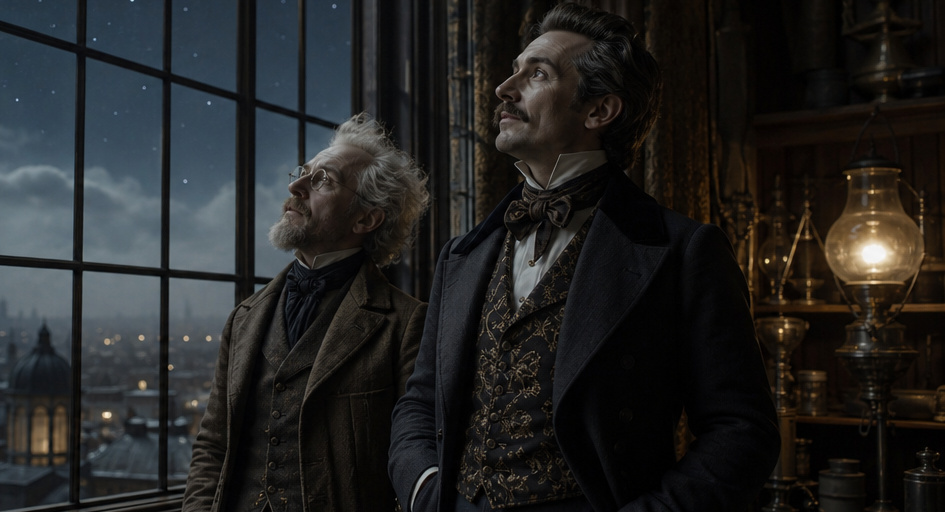
In 2009, the recently revived Eccentric Club set out to find the most eccentric man in Britain and discovered that its most obvious candidate wanted nothing to do with the title. The honour that year went, with great good humour, to an orange-painted superhero from Port Talbot who answers to the name of Captain Beany.
The Marquess of Bath - pony-tailed proprietor of Longleat, painter of Kama Sutra murals, keeper of a rotating court of companions he called wifelets - declined even to be considered. He was, he let it be known, sick and tired of being perceived as an eccentric. The Club, which never wastes a good gesture, wrote his refusal into the rules of the contest as the Lord Bath Rule. Three years afterwards he came to dinner anyway and accepted Honorary Life Membership. He would decline the label and keep the friends: a very English arrangement, and the whole subject folded into a single anecdote.
But let's consider the word itself. It began, improbably, in the heavens. To the astronomers of Ptolemy's school an eccentric was not a person but a path - a circle or orbit that did not hold the Earth precisely at its centre, from the Greek ekkentros, out of the centre. It travelled into English through the Latin of the schools and the French of the court, and for two hundred years it described planets and cog-wheels and nothing more temperamental. Only around 1685 did anyone think to fasten it to a human character, when the recently dead Earl of Shaftesbury, Anthony Ashley Cooper, was remembered as "the brightest yet the most eccentric soul". That astronomical sense is worth keeping in mind, because it is kinder and more exact than the modern one.
To be eccentric, properly understood, is neither to be mad nor to be flung outside the system altogether; it is to keep to your own orbit while the rest of the sky wheels around a centre you have chosen to ignore. The eccentric is not lost in space. He is merely not concentric.
It has always been a word that behaves differently according to the bank balance of its subject. The old saying holds that the rich are permitted to be eccentric where the poor are merely mad - and the record bears it out. When a destitute Newcastle character called William Barron, known to all as Billy Pea-pudding, died in the street in 1800, the local annals filed him under "an eccentric", which was the polite Georgian way of not looking too closely at a hard life. The marquess in his kaftan and the pauper in his rags were handed the same adjective and treated to opposite fates. The word, then as now, is partly a courtesy the comfortable extend to one another.
A birthright
The English have always regarded the whole business as an inheritance. Dame Edith Sitwell, cataloguing her national gallery of hermits and quacks and bath-dwelling lords in 1933, traced the appetite for the peculiar to a serene conviction of national infallibility - "the hallmark and the birthright of the British nation". An eighteenth-century French visitor, less flatteringly, put it down to fogs, beef and beer and the crushing tedium of the English Sunday. Both were describing the same phenomenon from opposite ends: a people so sure of itself, and so bored of an afternoon, that it can afford to let its odd fish swim.
We do not merely tolerate the eccentric; we keep him as a sort of national pet, pleased that he exists and relieved that he is not us.
Cross an ocean or a Channel, and the temperature of the world changes entirely. America, whose founding proverb promises that the squeaky wheel gets the grease, has no quarrel with the individual who insists on himself - but it prefers him to be going somewhere. American oddity is expected to monetise, scale, become a start-up, or, at the very least, a personal brand; the line between the visionary and the crank is drawn not by conduct but by results. Japan has kept a proverb pointing the other way - deru kugi wa utareru, the nail that stands proud of the plank is hammered flat - and yet the same country surrenders whole districts of Tokyo to the gorgeously strange each weekend, and grants its artists and its old cranks a licence the salaryman is denied. The Japanese eccentric is not forbidden; he is zoned.
An English import
France is the intriguing case, because France and England spent the better part of two centuries each insisting that the whole thing belonged to the other. To a certain sort of Englishman the notion seemed faintly continental, an affectation caught abroad like a head cold. The French returned the compliment with interest: to them it was unmistakably an English import, the natural produce of a post-Cromwellian island that had learned, ahead of its neighbours, to leave the individual character alone. When Voltaire and Montesquieu gazed across the water in the middle of the eighteenth century, they saw a land of reason, freedom and tolerance - Voltaire went so far as to wish himself reborn in "the Land of Liberty" - and the craze they helped to set loose, l'anglomanie, carried English gardens, English horses, English tailoring and English manners into every fashionable Paris salon.
But the idea travelled less comfortably than the waistcoats. Before 1800 the term excentrique was barely used in France at all; such people were "persons of the original character", and the French mind could not decide whether to salute them or to lock them up. It became a genuine and long-running quarrel - between the guardians of a settled Neo-Classical order and the newer voices pressing for something recognisably modern in taste and value, each side certain that the future was travelling in its direction. Eccentricity was the ground they fought over. In one light it stood for "English freedom... contrasted positively with French order and restraint" [1] - the enviable liberty of a people who declined, across their politics and religion, their dress and the schooling of their children, to be told what to do. In another it named precisely what a rational society ought to dread: the anti-social obsessive, absorbed in himself, rich in unaccountable habits and the occasional flash of genius, yet forever shading towards monstrosity or plain madness.
Two great waves of anglomanie broke over France - the first cresting before the Revolution, the second after the Empire had fallen - with the Napoleonic wars a bitter interruption between them, and the meaning of the word turned over with the tide each time. On the rising water eccentricity was glorious: rebellious, brave, a daring assertion of the self. On the ebb it curdled into something faintly absurd - whimsy, self-indulgence, a rich man's fancy. The English, meanwhile, went on prizing their eccentrics as proof of national good health, and the French went on suspecting theirs of a slightly foreign disease. Small wonder that when a Parisian at last wanted a name for the condition, he reached across the water and borrowed ours.
The upshot survives in the manners of both nations to this day. To be excentrique in Paris is permissible, even admired - provided one is exquisitely, deliberately so, in the lineage of the dandy who made a whole discipline of standing apart. The Englishman is eccentric by accident and rather proud of it; the Frenchman is eccentric on purpose and would sooner die than be caught trying.
The centre will not hold still
But the most interesting thing the word does is drift. Eccentricity is measured from a centre, and the centre refuses to keep its place. A great many habits that would once have marked a person as thoroughly peculiar have since strolled into the middle of the road and made themselves at home. To decline meat; to swim in cold seas for pleasure; to cover oneself in tattoos; to wear one's hair long as a man, or to keep a carefully tended beard; to work from a bedroom rather than an office; to sit out in the sun on purpose - each was, within living memory or just beyond it, the badge of a crank. Each is now unremarkable, or actively fashionable. The path the eccentric once traced alone has become the ring road everybody drives.
And the traffic runs both ways. As the centre migrates towards yesterday's oddity, a whole territory of the once-ordinary is left stranded on the far side, and the people still living there acquire, without shifting an inch, a strangeness they never sought. To dress for dinner; to write a letter by hand and post it; to keep the Sabbath; to learn a poem by heart; to do one thing at a time with the telephone switched off; to let a call ring on unanswered; to spend an afternoon that no screen has witnessed - these were the ordinary furniture of a life a century ago. Perform any of them today, and you will be marked down, gently, as an eccentric. Nobody redrew the map. The map moved under everyone's feet.
The Eccentric Club understood this drift long before most, and built its constitution upon it. Its members bound themselves, in a rule first set down in 1808, to leave politics and religion at the door and to cultivate instead two homely virtues - "Good Fellowship" and "True Sociality" - which even then they conceded were "getting rare and eccentric". Read that again. Two centuries ago, plain friendliness and good company were already scarce enough to rank as oddities worth preserving. The Club was never in the business of collecting lunatics. It was collecting the endangered ordinary - the courtesies and enthusiasms the centre was busy abandoning - and it has gone on doing so ever since, beneath an owl that carries a clock running backwards, stopped permanently and with enormous dignity at four o'clock. A club that keeps its own time is making a pointed argument about whose time is the correct one.
The reluctant and the ravenous
Which returns us to the late marquess, and to the modern predicament of the eccentric who does not wish to be one. Lord Bath spent six million words of autobiography and several decades of murals insisting, in effect, that he was an artist who happened to be unusual and not a curiosity who happened to paint. Those who knew him say the art was the serious business and the wifelets the sideshow the newspapers preferred; that, unburdened by ten thousand acres, he might have been taken at the valuation he wanted. This is the particular cruelty visited on the genuine article: the label arrives whether or not it is invited, and it arrives instead of the achievement.
Grayson Perry, no stranger himself to a frock at a prize-giving, has spent a career parrying the same question a journalist once put to him - was he a lovable character or a serious artist? "Can't I be both?" he replied, and the fact that he still has to ask is the whole of the difficulty.
At the opposite pole stands a more contemporary figure, and a far more anxious one: the person who wants the label so badly that he manufactures the oddity to earn it. Ours is the first age in which strangeness pays a dividend - in likes, in follows, in column inches - and the incentives have produced a lavish flowering of performed peculiarity: the deliberately clashing outfit, the calculated provocation, the personality assembled for the algorithm. At a glance, it resembles the real thing. But it is its exact opposite. The distinction is an old one: the French writer Pierre Maillaud, taking our measure in 1945, singled out the two merits that in his view lifted the true English eccentric above his foreign rivals - his oddity "does not depend upon his wallet", and, being no exhibitionist, he is content to be his own and only witness. [2] The genuine article would be precisely as odd on a desert island as at a gala, because his orbit is authentically his own and it has never once occurred to him to check whether anyone is looking. The performer cannot survive without the audience. Take away the camera and the eccentricity collapses, because it was only ever a costume worn towards it. One is a way of being. The other is a way of being seen.
This is the distinction the Club has always drawn, and it is why its role is stranger and gentler than any comment thread. Its members are, in the main, people who are simply and unrepentantly themselves and have found good company among others of the same disposition - the performers, the inventors, the barristers with the improbable hobby, elected not for the noise they make but for the originality they cannot help. That is the endangered thing the founders named in 1808, and it is rarer now than it was then, because the centre has swung so far and so fast that plain contentment in one's own oddity has itself become a minority pursuit.
The word, remember, began life as an orbit set off-centre. The centre the world now keeps is a restless, migrating, borrowed thing, forever chasing last season's rebellion and rechristening it the norm. The Eccentrics, beneath their backwards clock, decline to chase it at all. They keep to the path they were always on. It is the rest of the sky that has wandered.
Books quoted:
- M. Gill, Eccentricity and the Cultural Imagination in Nineteenth-Century Paris (Oxford: Oxford University Press, 2009), p. 31.
- Pierre Maillaud, The English Way (1945); the passage is quoted more fully in 'Contradiction in Terms'.

Comments (0)
No comments yet.
Commenting is for subscribers. Sign in or subscribe to join the conversation.