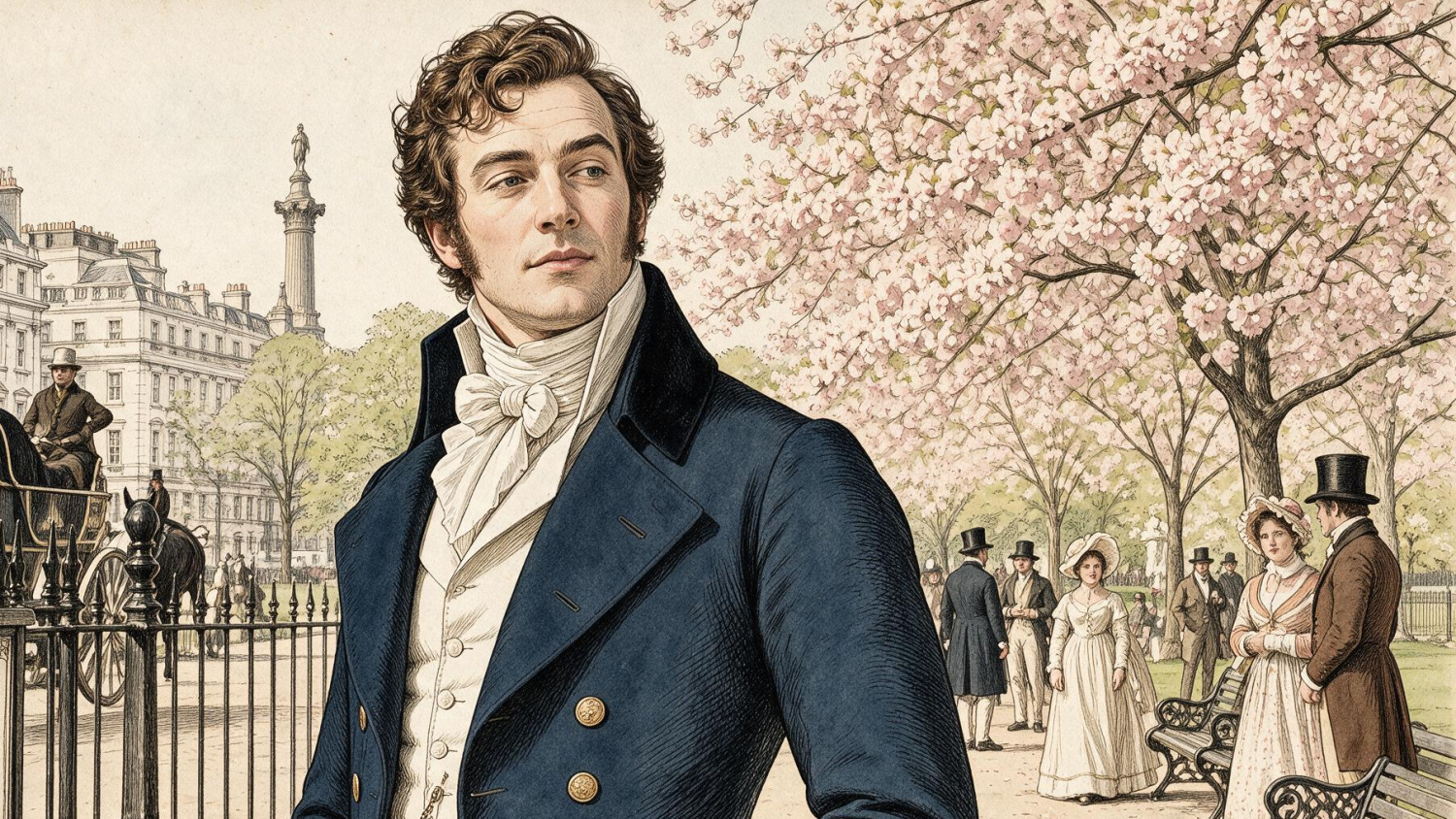
George (Beau) Brummell (1778-1840), the son of the upwardly-mobile secretary to Lord North, probably first met the Prince of Wales (later The Prince Regent) when Brummell was at Eton, on one of the Prince’s visits to the school. His wit won him royal notice and favour and, on 3 October 1799, he compounded it by sending the Prince a gift of a canister containing one pound of Fribourg & Treyer's Bureau blend snuff, at a cost of seven shillings and sixpence. He even took a commission in the 10th Light Dragoons (The Prince of Wales’ Own); until that regiment was unexpectedly ordered from Brighton to go north to Manchester – ‘’Think, your Royal Highness, Manchester!’’ and he felt bound to sell himself out; tactfully explaining to the Prince: ‘’Besides, you would not be there.’’
By his presence, wit and force of personality, rather than by grovelling, Brummell soon established himself as a man-about-town, with a generous patrimony, in a rented house, complete with valet and cook, at 4 Chesterfield Street, Mayfair and, by general agreement of the haut ton, became the acknowledged Leader of Fashion.
His advice was eagerly sought, even by the Prince, on everything from boot-blacking to coat-fitting to snuff-blending, and his remarkable influence was evident on the occasion that Fribourg & Treyer received an eagerly awaited consignment of Martinique snuff, which Brummell had overlooked. Faced with a full order book, Brummell simply went in, sampled the snuff, condemned it as unfit and, at the word of this going out, orders were hastily cancelled. He then bought three jars for himself. News of this volte face spread and, as he had predicted, the order book soon refilled. The snuff sold out.
Lady Hester Stanhope (niece of William Pitt the Younger and a great traveller, who earned the soubriquet 'Queen of the Desert'), criticised him for his airs and advised him to appear humbler. Brummell replied ‘’My dear Lady Hester, if I were to do as you advise me, do you think I could stand in the middle of the pit at the opera and beckon to Lorne (heir to the Duke of Argyll) on one side, and Villiers (later Lord Jersey), on the other, and see them come to me?’’
However, despite it all, Brummell gradually fell out of favour with the Prince; although Brummell continued (until he fled as a debtor on 16 May 1816), as a Leader of Fashion in the set of the Duke and Duchess of York.
One of the explanations for the upset with the Prince was that Brummell did not like the Prince’s mistress, Mrs Fitzherbert, and he did not hesitate to show his dislike. There were a professional boxer and a porter at Carlton House both nicknamed ‘Big Ben’, and there was also a vulgar fellow called ‘Benjamin’ who would ride close to the Prince in the Park to give the impression that he was a royal favourite. The Prince was growing corpulent, and Brummell took to referring to him behind his back as ‘Our Ben’ and to Mrs Fitzherbert as ‘Benina’. Unsurprisingly, the victims heard about it and were not pleased. However, Brummell went too far when he openly referred to Mrs Fitzherbert as Mistress Fitzherbert. After this, at a house party at Claremont, the Prince asked Brummell to leave, as soon as he arrived, to save Mrs Fitzherbert’s feelings, and he did so. Brummell then discovered that a snuff-box which the Prince had commissioned for him was not to be delivered to him. This stung Brummell, especially as the commission had been to replace a snuff-box which the Prince had insisted on taking from Brummell’s own collection. Interestingly, there was a particular snuff-box among Brummell’s effects, which were sold off by Mr Christie over 22-23 May 1816, and inside was a note which read: ’’This snuff-box was intended for the Prince Regent, if he had conducted himself with more propriety towards me.’’ What a relic to possess!
Brummell always denied as ridiculous a rumour that the rift was caused because he had, in company, seriously breached royal protocol by saying: ‘’Wales, ring the bell!’’ - something that he would never have done, although he also claimed that he might easily (and harmlessly) have said it if he had been alone with the Prince.
However, for some time still, Brummell’s luck in gambling held and he even reputedly ruined George Harley Drummond, a member of Drummond’s Bank, in a single evening’s play.
Indeed, Brummell, Lord Alvanley, Sir Henry Mildmay and Henry Pierrepont were all enjoying such a good run that they decided to give the ‘Dandies’ Ball’ to celebrate. Various accounts of the event suggest that it took place in July 1813, and when Brummell’s first biographer, William Jesse, mentions the ball in volume 1 (first published in 1844), he places it in the Argyle (Argyll) Rooms. These were subscription assembly rooms in what is now Little Argyll Street. Jesse tells us that, although the Prince was on bad terms with Brummell and Mildmay, he did attend the ball but had ‘cut’ Brummell and Mildmay at the entrance, with the result that Brummell had simply declined to attend the Prince to his carriage when he left.
However, in the Appendix to Jesse’s biography, there is an anonymous but allegedly first-hand account of the Dandies’ Ball from someone who knew Brummell well. According to this account, the ball was held in the Hanover Square Rooms:
“O could I as Harlequin frisk,
And thou be my Columbine fair,
My wand should, with one magic whisk,
Transport us to Hanover Square…”
(‘Rejected Addresses’ by W. Spencer: ‘The Beautiful Incendiary’ (1812)).
The second account runs as follows: ‘’When the approach of the Prince was announced, each of the four gentlemen took, in due form, a candle in his hand. Pierrepo(i)nt, as knowing the Prince, stood nearest the door, with his wax light, and Mildmay, as being young and void of offence, opposite. Alvanley, with Brummell opposite, stood immediately within the other two. The Prince at length arrived, and, as was expected, spoke civilly and with recognition to Pierrepo(i)nt, and then turned, and spoke a few words to Mildmay; advancing, he addressed several sentences to Alvanley, and then turned towards Brummell, looked at him, but as if he did not know who he was, or why he was there, and without bestowing upon him the slightest symptom of recognition. It was then, at the very instant he passed on, that Brummell, seizing with infinite fun and readiness the notion that they were unknown to each other, said across to his friend, and aloud, for the purpose of being heard:
"Alvanley, who's your fat friend?"
Those who were in front, and saw the Prince's face, say that he was cut to the quick by the aptness of the satire."
However, there are even accounts which have Brummell uttering the words in St James’s Street. Thomas Raikes, in his A Portion of a Journal Kept by Thomas Raikes Esq., from 1831-1847 (rather after the event), said that Brummell saw Jack Lee in the street speaking to the Prince and straight away said to Lee ‘’Who’s your fat friend?’’, mortifying the Prince. Raikes then relates Thomas Moore’s parody of a letter from the Prince to the Duke of York, in Moore’s Twopenny Postbag (1813):
‘’I indulge in no hatred, and wish there may come ill
To no mortal, except, now I think on’t, Beau Brummell
Who declared t’other day, in a superfine passion,
He’d cut me and bring the old King into fashion.’’
Another version has the Prince and Lord Moira stopping to talk to Lord Alvanley who was with Brummell on a morning walk; the Prince ignored Brummell and, as he moved on, Brummell said to Alvanley, "Alvanley, who’s your fat friend?"
Lord Houghton (born R M Milnes (1809-1885)) puts the incident at a function in Burlington House but, given that he was barely four in July 1813, he plainly was not a witness!
It has been said that the Prince Regent would not, as a guest, have ‘cut’ any of his hosts at a ball. However, we might recall the very public humiliation that he (‘the first gentleman of Europe’) later inflicted on Queen Caroline. First, he (unsuccessfully) tried to divorce her for adultery and strip her of her title by the Pains and Penalties Bill (during the course of which, Caroline was effectively tried before the House of Lords), and then he had her physically barred with bayonets from his coronation; the doors of Westminster Abbey slammed in her face.
Whichever account of Brummell’s retort is the right one, it seems highly likely that Brummell did make it in return for being ‘cut’ by the Prince, and it has become central to the Brummell legend. Moreover, it seems most probable that he made it at the Dandies’ Ball, which was held in July 1813.
There were other instances of Brummell annoying the Prince Regent at this time. One account (also anonymously relayed to Jesse) mentions an incident in the lower waiting room at the opera (in a lost building on the site of Her Majesty’s Theatre). The Prince was waiting with his suite for his carriage, and Brummell entered the waiting room with friends. Not seeing the Prince, Brummell was pressed further and further back towards the Prince and, had not a member of the Prince’s suite tapped Brummell on the shoulder, they would have collided. Brummell turned sharply around:-
‘’and saw that there was not much more than a foot between his nose and the Prince of Wales's. I watched him with intense curiosity, and observed that his countenance did not change in the slightest degree, nor did his head move; they looked straight into each other's eyes; the Prince evidently amazed and annoyed. Brummell, however, did not quail, or show the least embarrassment. He receded quite quietly, and backed slowly step by step, till the crowd closed between them, never once taking his eyes off those of the Prince.
It is impossible to describe the impression made by this scene on the by-standers; there was in his manner nothing insolent, nothing offensive; by retiring with his face to the Regent he recognized his rank, but he offered no apology for his inadvertence, (as a mere stranger would have done), no recognition as an acquaintance; as man to man, his bearing was adverse and uncompromising.’’
An account of a more amusing encounter was also given to Jesse by an eyewitness:
‘’His Royal Highness was going to the Picture-Gallery in Pall Mall, and Brummell, who was walking with some other man about ten yards in front of me, was exactly opposite the door of the exhibition, as the low, dark red carriage stopped. Brummell evidently saw it, and saw who was in it, though he pretended not to do so, and when the two sentries presented arms, he, with an air of affected surprise and mock dignity, which was most amusing, gravely raised his hat, as if the salute had been to him: as he did this he paused, turning his head very graciously towards the sentries, and his back to the carriage window, which he was quite close to. I saw, as I passed, the Regent’s angry look, but he said nothing.’’
Brummell always maintained that his gambling wins turned to gambling losses when he lost a lucky sixpence with a hole in it, and then he even lost the loans that he had taken out to make good the original losses. London became too hot for him, and he fled to Calais over the night of 16 May 1816.
In September 1821 George IV passed through Calais, and spotted Brummell, caught up in the press of the crowd. The Prince had exclaimed ‘’Good God – Brummell!’’ Brummell had gone deathly pale and had then gone inside. During his stay, the King ran dry of snuff, and some was sent for. When he tried the fresh supply, the King asked Sir Benjamin Bloomfield:
‘’Why, sir, where did you get your snuff? There is only one person I know who can mix snuff in this way.’’
Bloomfield replied to the king: ‘’It is some of Mr Brummell’s, Sir’’ and there the conversation ended. One might speculate whether, if Brummell had swallowed his pride and taken his bow, he might have been forgiven for their breached friendship and considerably helped. Instead, he had before him nearly nineteen years of begging his remaining friends for sustenance. The King left Calais, observing, maybe sadly, to Sir Arthur Paget in his party: ‘‘I leave Calais and have not seen Brummell …’’. They never met again. However, Ian Kelly tells us in his biography of Brummell that, despite everything that had happened, one of George IV’s death bed acts was to sign Brummell’s appointment as British Consul at Caen.
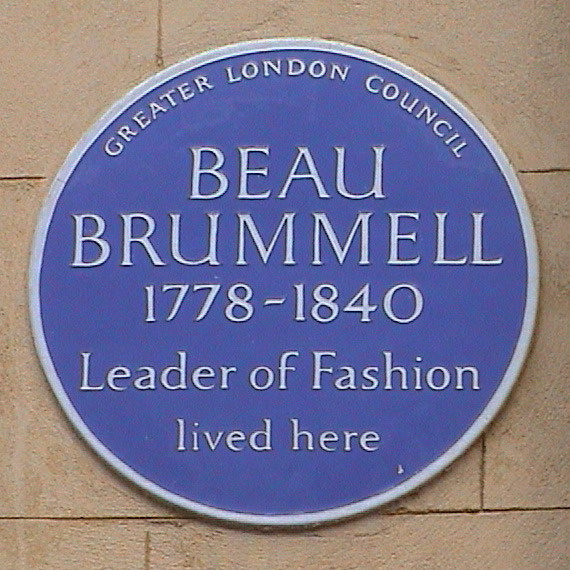
The last chapter of Jesse’s biography ruefully makes the point that Brummell would ultimately be forgotten. Yet, there is a London County Council commemorative blue plaque on the front of 4 Chesterfield Street and a magnificent statue (dated 2002, by Irena Sedlecka), funded by subscription, in Jermyn Street, commanding the entrance to the Piccadilly Arcade. Many much more industrious men of the Regency age have been forgotten, and they could chorus:
‘Lo, all our pomp of yesterday
Is one with Nineveh and Tyre.’
Yet Brummell, as it turns out, is well remembered - and with glee!
Byron (himself possessed of an excoriating wit), said that Brummell was one of the great men of the age; placing himself third; Napoleon second, and Brummell first. It has also been nicely observed that Bonaparte and Brummell 'nearly fell together'. Leigh Hunt told Jesse that he recalled Byron saying about Brummell’s appearance that: ‘’there was nothing remarkable in his style of dress except a certain exquisite propriety’’.
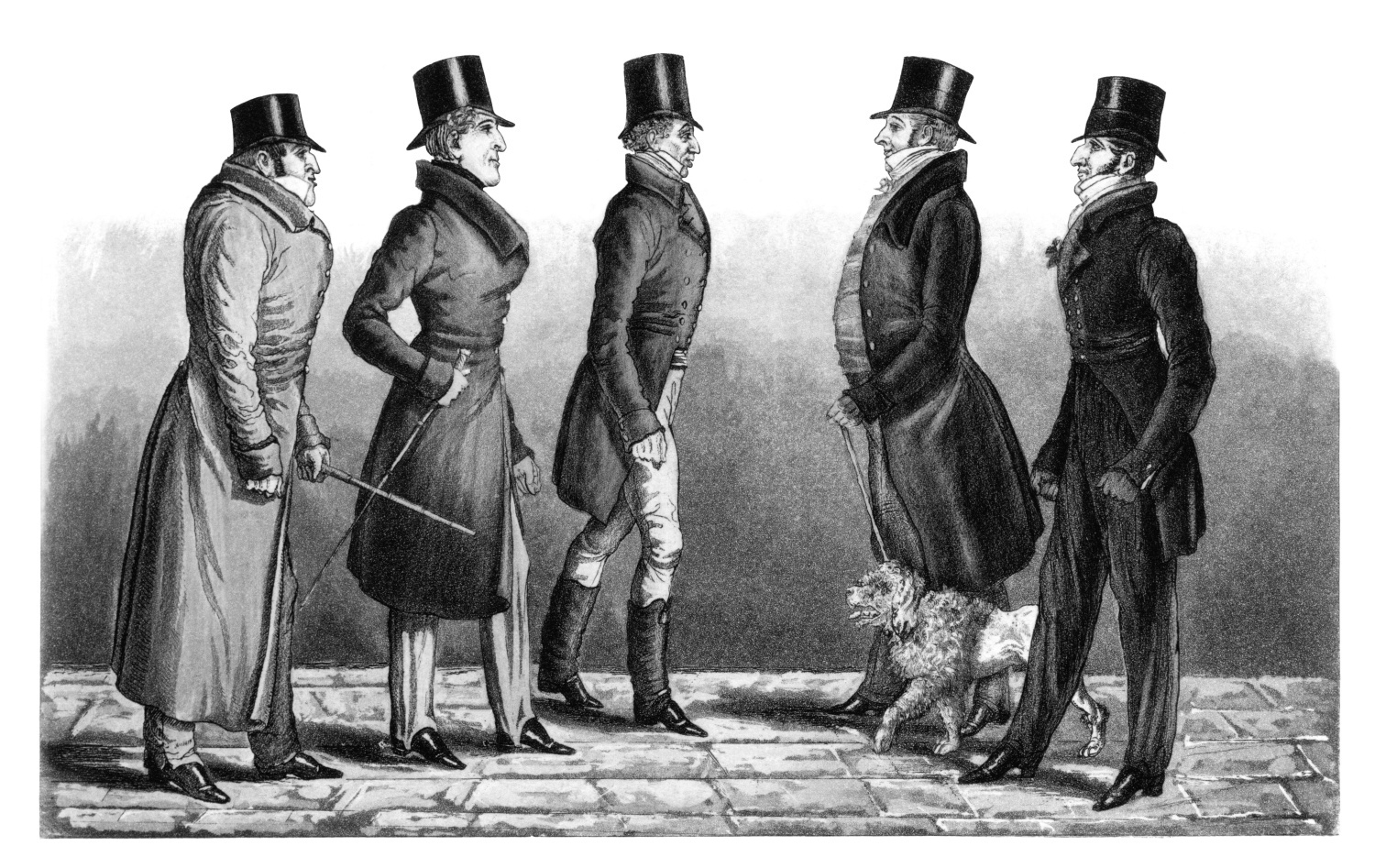
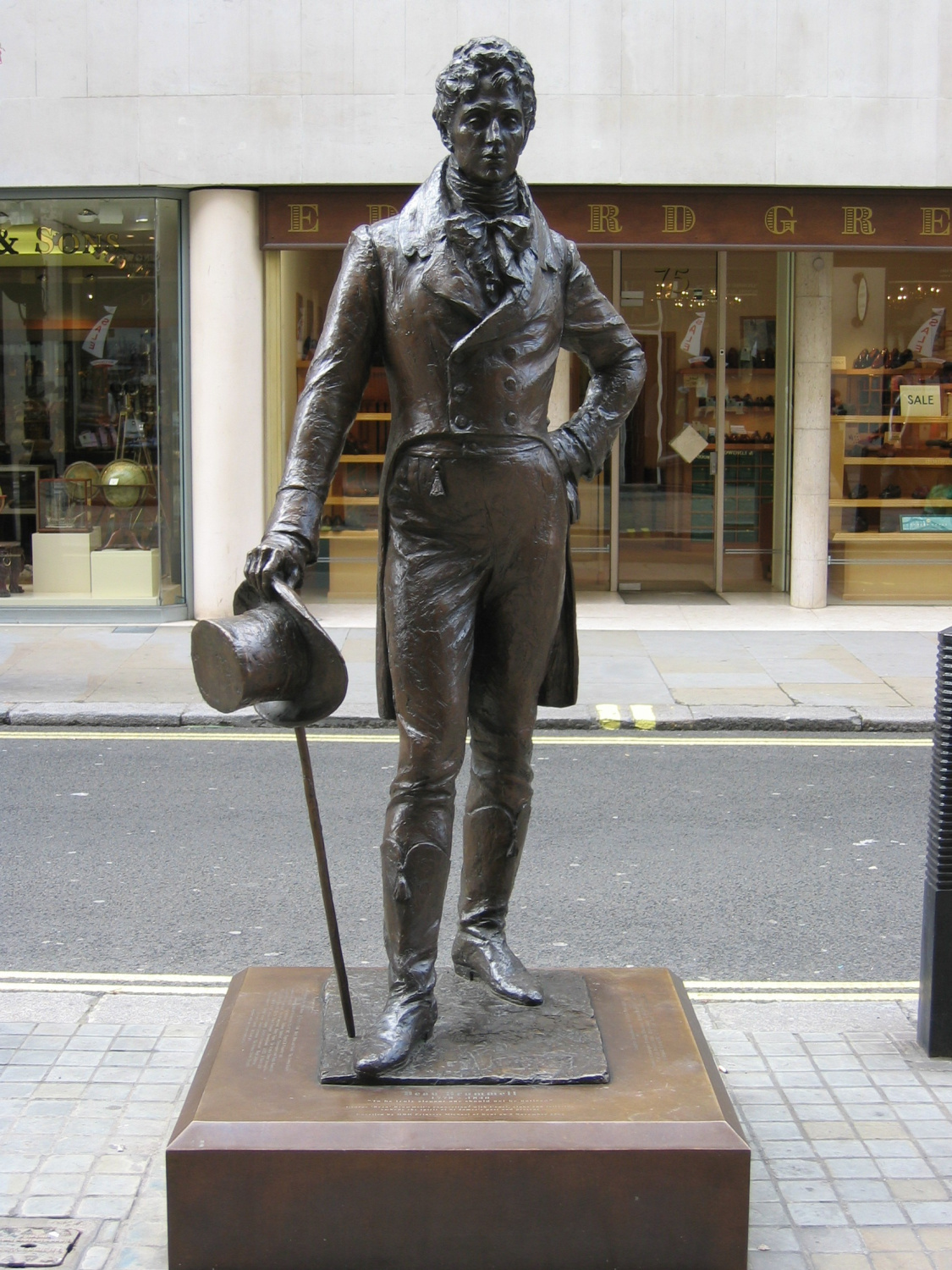 At the end of the day, Brummell is principally remembered for his character, his perfectionism, and as an icon of originality; of a determined defiance, and for the force of a solipsistic and seemingly disengaged personality; most famed for his amusing distraction in: the tie of his cravat; the fit of his coat; the polish of his boots; the ‘’nice conduct of a clouded cane’’; his indulgence in Georgian feasts and their deep potations; as well as a liking for ‘’the music of the dice box’’, and the (ultimately) doom-laden dealing of the cards on the baize, in a gaming ‘Hell’ in Jermyn Street; from which he emerged, broken, and went up to Watier’s club, exclaiming that he was: without a shilling to his name, in the world.
In the modern age, our leading politicians, professionals and higher executives increasingly see some populist advantage in schlepping around, in pursuit of votes and riches, in open-necked shirts and saying to total strangers: ‘’Call me Tim’’.
However, occasionally, every modern man has the occasion to need to dress properly: a wedding; a baptism; a funeral; Royal Ascot, or for some event requiring white or black-tie evening dress. If he has any sense at all, when he finally looks at himself, he will see Brummell, ironic and knowing, staring back at him, from a fourth dimension within the looking glass; suggesting that ‘’your tie looks too carefully arranged.’’
The modern man of sense will take the hint and, quite deliberately, he will avoid the fault by expending the extra effort needed, only just to spoil its perfect symmetry.

Comments (0)
No comments yet.
Commenting is for subscribers. Sign in or subscribe to join the conversation.