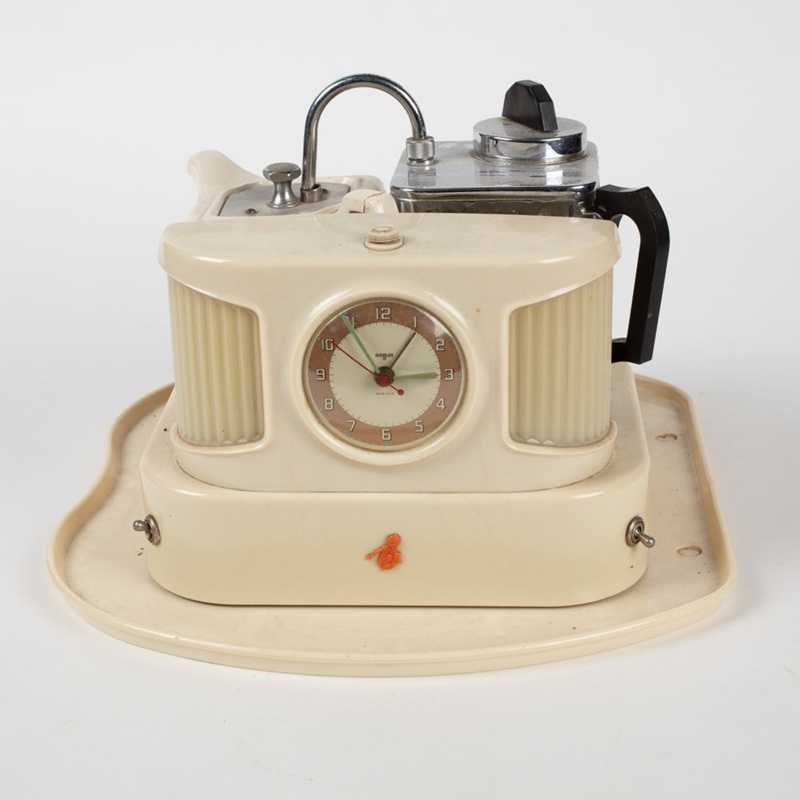
The word eccentric is almost never applied by the living to themselves. It is often a verdict, delivered afterwards, by people who have had the benefit of knowing how things turned out. This is as true of objects as it is of persons. Nobody in 1902 registered a patent for an apparatus whereby a cup of tea or coffee is automatically made while thinking of himself as a comic figure. He thought he was going to be rich. That he was wrong is a fact about commerce rather than about his intelligence, and the distinction is worth holding on to for the hour it takes to walk round the show now installed at Nuneaton.
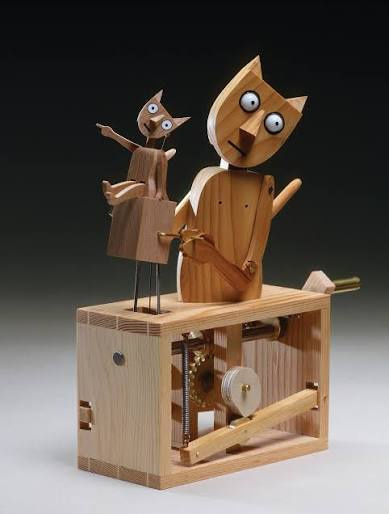
Eccentric Contraptions opened in Riversley Park on 25 July and runs to 19 September. It consists of rather more than a hundred pieces lent by the collector Maurice Collins, drawn from a private holding that has now passed three and a half thousand items. The council's listing gives the flavour: a Teasmade, a window burglar alarm, a salesman's washing machine of 1894, a pea podder, a wrinkle eradicator, a heel protector, something billed as a Victorian laptop, something else billed as an early sat nav, and — the notice does not trouble to explain itself here — a gunpowder keg. Visitors are invited to work out what each thing was for. The invitation is well meant, and admission is free, which disposes of the two objections one might otherwise be tempted to raise.
The guessing game is agreeable enough on a wet Thursday in August, and it is the least interesting thing on offer. Its premise is that these objects puzzle us because they are silly. They puzzle us because the problems they answered have gone away. A moustache spoon is not a foolish design; it is an entirely rational response to the collision of hot soup with moustache wax, and it ceased to make sense in the 1920s because men stopped waxing their moustaches, not because spoons improved. The salesman's washing machine is a full apparatus shrunk to the dimensions of a sample case, which tells us a great deal about Victorian selling and almost nothing about Victorian laundry. Obsolescence, in this room, is nearly always a fact about the world rather than about the workmanship.
The exhibit that should detain a careful visitor longest is the sat nav, and it deserves its billing more than the phrase suggests. The Plus Fours Routefinder, made in England in the 1920s, was worn on the wrist. Paper maps were wound around rollers and advanced by hand as the driver went, showing the mileage and issuing a stop instruction at journey's end. Each scroll covered one route in one direction; a return trip required a fresh one, and a change of mind required a change of cartridge. Collins found his at an antiques fair in the south of England and has never come across a second. It went on public display at the British Library in 2008 and has circulated online ever since as a punchline.
The joke has a defect. A century on, a very large number of people navigate by a scrolling map strapped to the wrist which advances as they move and tells them when to stop. What the Routefinder lacked was not the idea. It lacked satellites, a road network worth the name, and enough motorists to make a production run pay. Being right in 1925 and being wrong in 1925 looked identical from the inside, and the survivors are called visionaries only because somebody eventually bought them.
A fair-minded visitor should nonetheless allow that not everything in this trade was honest. The wider Collins hoard includes a nose shaper and an asthma-curing necklace; Nuneaton offers a wrinkle eradicator. These were not attempts to spare anybody labour but attempts to sell hope, and the distance between the pea podder and the wrinkle eradicator is the distance between engineering and quackery. The display does not draw that line on the visitor's behalf, which is probably the right decision, since drawing it oneself is the more instructive exercise.
The other exhibit, and the one not in a case, is Collins. He was born in the East End in the middle 1930s, served in the Royal Air Force, and ran a printing firm that made boxed games and cartons — a working life spent on the packaging of other people's diversions before he turned to the diversions themselves. The collecting began around 1976 at a rubbish tip near his home in north London, where he had taken his teenage son bottle-digging. The origin is almost too neat: a great assembly of curiosities begun at the precise place where objects go in order to stop being interesting. He holds an OBE, though not for any of this. The honour was for his work with disabled people; he co-founded the charity Kith & Kids and chaired Haringey Mencap. When a shopping channel named him Britain's best collector in 2011 and handed over two thousand pounds, he gave it to the charity. There is a consistency here that it would be vulgar to labour.
The Teasmade, meanwhile, has a stronger local claim than the show is likely to press. Samuel Rowbottom of Derby applied for the first patent in December 1891, using a clockwork alarm, a gas ring and a pilot light — the pilot light being the detail that explains why the nation did not immediately begin waking to tea. The first workable design came from Albert E. Richardson, an iron turner from Ashton-under-Lyne, who sold it outright to Frank Clarke, a Birmingham gunsmith. Clarke patented it in 1902 under the magnificently unhelpful title of An Apparatus Whereby a Cup of Tea or Coffee is Automatically Made, then sold it, far more sensibly, as A Clock That Makes Tea. Note the trade. The men who could build a mechanism dependable enough to be trusted at the shoulder were the men who could build one dependable enough to be trusted at the bedside. Electricity made the thing practical in the 1930s, the 1960s made it universal, and the espresso machine eventually saw it off.
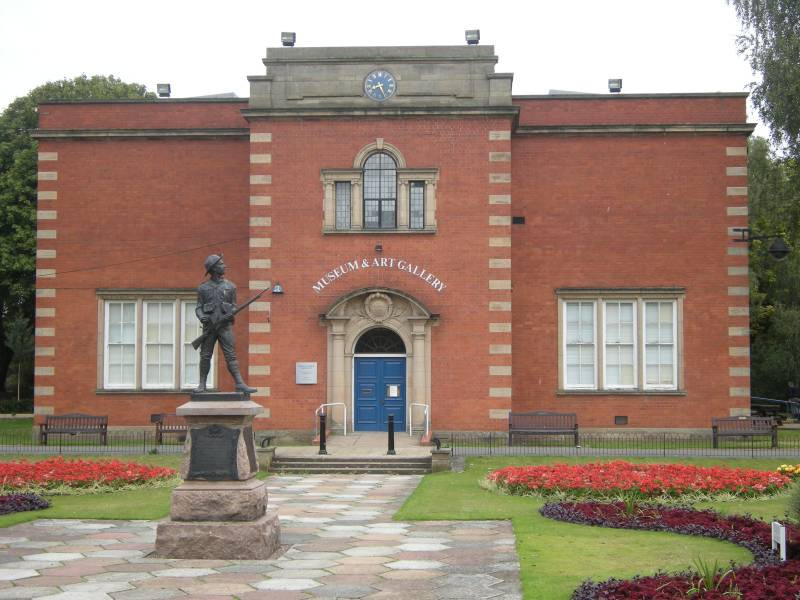
 That such a display should land here is a small piece of luck for the town and a rather larger piece of aptness. The museum was a gift from Edward Melly, a colliery manager who paid for the building and had already given the park; it opened on 1 April 1917, which one hopes was nobody's idea of a comment. A bombing raid in 1941 killed Melly and wrecked much of what he had funded, taking the records with it, and the galleries were not fully back in use until 1960. Upstairs there is a reconstruction of George Eliot's London drawing room of 1870, with her dress and her shoes. Elsewhere there is Larry Grayson's bow tie and the chair he used on stage. A woman who took a man's name in order to be read, and a man who built a career out of a catchphrase and a seat, now keep company with a hundred devices that nobody wanted. It is a more coherent building than it first appears.
There are free craft activities on Thursdays and Fridays, which will occupy the children. The adults should be left to the harder task, which is not deducing the purpose of the pea podder but recognising the impulse behind it. Every object in these rooms was made by somebody who looked at an ordinary afternoon and concluded it could be improved. Most of them were mistaken. All of them were serious.
Go and be baffled, by all means. Then go home and open the drawer where you keep the things that came with other things. Its contents were designed by people exactly as confident as Samuel Rowbottom, and in eighty years somebody will be invited to guess.
Eccentric Contraptions is at Nuneaton Museum & Art Gallery, Riversley Park, Coton Road, Nuneaton CV11 5TU, until Saturday 19 September. Admission free; donations welcomed. Free craft activities for younger visitors on Thursdays and Fridays.
Comments (0)
No comments yet.
Commenting is for subscribers. Sign in or subscribe to join the conversation.